
What Is Understanding Tabu Registration in Israel?
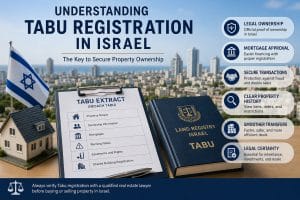 Understanding Tabu Registration in Israel is one of the most important parts of buying, selling, inheriting, or investing in real estate in Israel. Anyone purchasing property in Israel must understand how the Tabu system works because ownership rights, legal protections, mortgages, easements, and property history are all connected to this registration framework.
For foreign buyers, new immigrants, investors, and even many Israelis, Understanding Tabu Registration in Israel can initially appear complicated because Israel uses several parallel land registration systems. However, once the structure is understood, the process becomes far clearer.
The word “Tabu” refers to the Israeli Land Registry, officially managed by the Israeli Ministry of Justice. The registry records legal ownership and rights connected to real estate throughout Israel. When a property is properly registered in Tabu, the ownership rights become legally recognised and publicly searchable.
Understanding Tabu Registration in Israel is critical because not all apartments, homes, or land plots in Israel are registered in the same way. Some properties are registered directly in Tabu, while others may still be registered through the Israel Land Authority, private companies, housing corporations, or developers.
This distinction matters enormously because it affects financing, resale ability, legal security, inheritance procedures, taxes, and even the speed of future transactions.
The Historical Background of Tabu Registration
Understanding Tabu Registration in Israel requires some knowledge of history. The term “Tabu” originates from the Ottoman Empire. During Ottoman rule, land registration systems were established throughout the region. Many aspects of modern Israeli land registration still derive from these historical structures.
Following the Ottoman period came the British Mandate era, during which additional mapping and land registration procedures were introduced. After the establishment of the State of Israel in 1948, Israel modernised and expanded the system while maintaining certain inherited legal frameworks.
Today, Understanding Tabu Registration in Israel involves recognising that the registry serves as the official proof of ownership for many properties in the country. The system has gradually become digitised, allowing lawyers and property professionals to access land records online.
However, due to Israel’s complex legal and historical land structure, some properties remain partially unregistered or registered under alternative systems.
Why Understanding Tabu Registration in Israel Matters
Understanding Tabu Registration in Israel is essential because property ownership in Israel is heavily dependent on formal registration. Unlike some countries where possession alone can create strong legal standing, Israeli real estate law prioritises formal registration.
Several major reasons explain why Understanding Tabu Registration in Israel matters:
Legal Ownership Protection
The Tabu registry establishes official ownership rights. Without proper registration, proving ownership can become difficult during disputes or inheritance claims.
Mortgage Approval
Israeli banks strongly prefer properties properly registered in Tabu. If a property lacks proper registration, obtaining financing may become harder or more expensive.
Easier Property Transfers
Properties with clean Tabu registration usually sell faster because buyers and lawyers can verify ownership more efficiently.
Avoiding Fraud
Understanding Tabu Registration in Israel helps buyers avoid fraudulent transactions involving disputed ownership or unauthorised sales.
Verification of Rights
The registry shows mortgages, liens, warnings, easements, and legal restrictions connected to the property.
What Information Appears in a Tabu Extract?
One of the central aspects of Understanding Tabu Registration in Israel is knowing how to read a Tabu extract, known in Hebrew as a “Nesach Tabu.”
This document contains important legal information about the property.
Property Details
The extract identifies the property through block and parcel numbers. Israeli real estate identification depends heavily on these numerical references.
Ownership Information
The registered owners appear in the extract, including percentages of ownership where applicable.
Mortgages
Existing mortgages registered against the property are listed.
Warning Notes
Warning notes, called “He’arat Azhara,” indicate pending transactions or obligations.
Easements and Rights
Rights of passage, usage restrictions, or other legal rights connected to the property may appear.
Shared Building Registration
For apartments, the extract may identify the shared building structure and communal areas.
Understanding Tabu Registration in Israel means learning to interpret these details carefully because mistakes or omissions can create significant legal problems later.
Different Types of Land Ownership in Israel
One reason Understanding Tabu Registration in Israel can become confusing is that Israel has multiple land ownership structures.
Private Ownership
Some land is privately owned and fully registered in Tabu.
Israel Land Authority Land
Much Israeli land is technically state-owned and leased long-term through the Israel Land Authority.
Church-Owned Land
Certain areas, especially in Jerusalem, are owned by churches and leased to residents.
Jewish National Fund Land
Some land belongs to the Jewish National Fund and is administered under separate arrangements.
Understanding Tabu Registration in Israel requires recognising that ownership rights vary depending on the underlying land structure.
Understanding Shared Buildings and Condominium Registration
Many apartments in Israel exist within shared buildings. Therefore, Understanding Tabu Registration in Israel also involves understanding condominium registration.
In Israel, a shared apartment building is often registered as a “Bayit Meshutaf,” meaning shared house.
This registration defines:
- Individual apartment ownership
- Shared areas
- Storage rooms
- Parking spaces
- Roof rights
- Garden rights
Without proper condominium registration, disputes regarding parking, balconies, storage, or renovations can emerge.
For apartment buyers, Understanding Tabu Registration in Israel means confirming that all attached rights actually appear in the registration documents.
Warning Notes and Their Importance
A key component of Understanding Tabu Registration in Israel is the concept of warning notes.
A warning note protects buyers during transactions. Once signed, the buyer’s lawyer usually registers a warning note immediately.
This prevents:
- Double sales
- Unauthorised transfers
- Additional mortgages
- Fraudulent transactions
Understanding Tabu Registration in Israel means recognising that warning notes provide critical interim legal protection before final ownership transfer occurs.
Without such protection, sellers could theoretically attempt conflicting transactions.
The Difference Between Tabu Registration and Contract Rights
Understanding Tabu Registration in Israel also means understanding that contract rights and registered ownership are not identical.
Many buyers mistakenly believe signing a purchase agreement automatically creates full ownership rights. In practice, registration completion is the decisive legal step.
Some new developments remain registered only through the developer for years before formal Tabu registration occurs.
This creates several risks:
- Delayed ownership recognition
- Administrative complications
- Difficulties obtaining mortgages
- Future resale delays
Understanding Tabu Registration in Israel helps buyers identify these risks before purchase.
New Construction and Delayed Registration
One major issue affecting Understanding Tabu Registration in Israel is the delayed registration of new developments.
In many Israeli projects, buyers initially receive contractual rights rather than direct Tabu ownership.
The process usually works like this:
- Developer purchases land
- Construction begins
- Buyers sign contracts
- Occupancy occurs
- Shared building registration takes place
- Individual ownership registration follows
This process may take years.
Understanding Tabu Registration in Israel is particularly important when buying “on paper” apartments because delays in registration are common.
Buyers should verify:
- Whether land registration is complete
- Whether subdivision approvals exist
- Whether condominium registration has started
- Whether legal obstacles remain
The Role of Lawyers in Understanding Tabu Registration in Israel
Real estate lawyers play a central role in Understanding Tabu Registration in Israel.
An experienced Israeli property lawyer performs several essential checks:
Ownership Verification
The lawyer confirms the seller legally owns the property.
Debt Examination
Mortgages, liens, taxes, and legal claims are checked.
Planning Verification
Building permits and municipal compliance are reviewed.
Warning Note Registration
The lawyer protects buyer rights during the transaction.
Final Ownership Transfer
The lawyer handles registration completion.
Attempting Israeli property transactions without proper legal guidance creates major risks.
Understanding Tabu Registration in Israel requires recognising that registration law is technical and often highly specific.
How Foreign Buyers Should Approach Tabu Registration
Foreign buyers often underestimate the importance of Understanding Tabu Registration in Israel.
Many overseas buyers focus heavily on location, price, or emotional attachment while ignoring legal registration details.
This can become expensive.
Foreign buyers should verify:
- Exact ownership status
- Land classification
- Lease duration
- Existing encumbrances
- Registration delays
- Municipal compliance
- Developer obligations
Understanding Tabu Registration in Israel is especially important for overseas investors because resolving legal problems remotely becomes far harder.
Understanding Tabu Registration in Israel and Mortgages
Israeli banks examine registration carefully before approving mortgages.
A clean Tabu registration generally improves financing terms.
Banks review:
- Ownership validity
- Existing debts
- Warning notes
- Property status
- Lease duration
- Building legality
Understanding Tabu Registration in Israel is therefore closely linked to financing strategy.
Properties with incomplete registration may face:
- Higher down payment requirements
- Slower approvals
- Reduced financing percentages
- Additional legal demands
Common Problems Found During Tabu Checks
Understanding Tabu Registration in Israel also means understanding common problems that appear during legal due diligence.
Unregistered Additions
Illegal balcony closures or extra rooms may exist.
Missing Parking Rights
Advertised parking spaces may not appear legally.
Inheritance Disputes
Some properties remain partially inherited without completed registration.
Unremoved Mortgages
Old loans may still appear in the registry.
Boundary Problems
Land borders may not align properly.
Shared Ownership Issues
Multiple heirs or owners may complicate sales.
Understanding Tabu Registration in Israel helps buyers detect these issues before signing contracts.
Understanding Leasehold Properties
A major issue within Understanding Tabu Registration in Israel involves leasehold ownership.
Much Israeli land is technically leased rather than fully owned.
Lease durations often extend for:
- 49 years
- 98 years
- 196 years
Although long-term leases function similarly to ownership in practice, they still carry legal implications.
Understanding Tabu Registration in Israel means examining:
- Remaining lease years
- Renewal conditions
- Transfer fees
- Land authority obligations
Certain foreign buyers incorrectly assume all Israeli property constitutes freehold ownership.
The Israel Land Authority and Registration
The Israel Land Authority plays a central role in Israeli real estate.
Understanding Tabu Registration in Israel therefore requires understanding how the Authority interacts with ownership rights.
The Authority administers much state land.
This creates additional layers involving:
- Lease approvals
- Transfer permissions
- Capitalisation fees
- Usage restrictions
Some transactions require additional bureaucratic procedures beyond standard Tabu registration.
This can delay deals.
Registration During Inheritance
Inheritance procedures also highlight the importance of Understanding Tabu Registration in Israel.
When property owners die, inheritance orders or probate orders must often be registered formally.
Failure to update registration can create serious future complications.
Heirs may later encounter:
- Sale delays
- Ownership disputes
- Tax complications
- Financing difficulties
Understanding Tabu Registration in Israel therefore matters not only for buyers but also for families planning inheritance and estate management.
Urban Renewal Projects and Tabu Registration
Urban renewal projects such as Tama 38 and Pinui Binui create additional registration complexity.
Understanding Tabu Registration in Israel becomes even more important in redevelopment situations because ownership structures may temporarily change.
Issues can include:
- New apartment numbering
- Additional ownership rights
- Temporary legal arrangements
- Shared ownership restructuring
Buyers entering redevelopment projects must carefully examine how registration updates will occur after completion.
Understanding Tabu Registration in Israel for Investors
Property investors should treat Understanding Tabu Registration in Israel as a core due diligence process.
Registration quality affects:
- Liquidity
- Financing
- Risk profile
- Exit strategy
- Tenant confidence
- Resale timing
Experienced investors usually prefer:
- Fully registered apartments
- Clean ownership chains
- Proper condominium registration
- No unresolved liens
Investors buying discounted properties with registration problems may achieve higher returns but also assume substantially higher legal and administrative risks.
Digitalisation and Modernisation of Tabu Records
Israel has modernised much of the Tabu system.
Today, many records are accessible digitally.
This has improved:
- Speed
- Transparency
- Verification
- Lawyer efficiency
However, Understanding Tabu Registration in Israel still requires professional interpretation because digitisation has not eliminated legal complexity.
Historical inconsistencies, overlapping rights, and old registration structures still exist.
Municipal Records vs Tabu Registration
One important aspect of Understanding Tabu Registration in Israel is recognising that municipal records and Tabu records are not identical.
Municipal property tax records do not prove ownership.
Likewise, utility payments do not establish legal title.
Only proper registration determines official ownership.
Buyers who rely solely on municipal records risk serious legal problems.
Risks of Buying Without Proper Registration Checks
Understanding Tabu Registration in Israel helps buyers avoid dangerous mistakes.
Purchasing property without proper checks can expose buyers to:
- Ownership disputes
- Hidden debts
- Illegal construction
- Planning violations
- Delayed resale
- Mortgage refusal
- Financial losses
Some foreign buyers wrongly assume Israeli transactions function identically to transactions in their home countries.
This assumption can become costly.
Understanding Tabu Registration in Israel and Building Rights
Building rights significantly affect property values in Israel.
Understanding Tabu Registration in Israel includes reviewing whether additional building rights exist.
In some cases, roof rights or expansion rights may belong to specific apartments.
These rights can dramatically affect value.
For example:
- Roof ownership may permit penthouse expansion
- Garden rights may increase resale appeal
- Future extension rights may raise investment potential
These details must appear clearly in registration documents.
Agricultural Land and Registration Complexity
Agricultural land creates additional complexity.
Understanding Tabu Registration in Israel becomes especially important when dealing with agricultural plots because zoning restrictions may limit development.
Speculative buyers sometimes purchase agricultural land expecting rezoning approval.
However:
- Rezoning may never occur
- Infrastructure may remain absent
- Development permissions may face delays
Registration alone does not guarantee development rights.
The Role of Surveyors
Surveyors also contribute to Understanding Tabu Registration in Israel.
Surveyors verify:
- Boundaries
- Measurements
- Encroachments
- Building conformity
In some transactions, discrepancies between actual structures and registered plans may emerge.
These discrepancies can affect financing and legality.
Tax Implications Connected to Registration
Tax authorities also rely on ownership registration.
Understanding Tabu Registration in Israel therefore intersects with:
- Purchase tax
- Capital gains tax
- Betterment tax
- Inheritance considerations
Improper registration can complicate future tax reporting and compliance.
Why Buyers Should Never Rush Registration Checks
Israeli property markets, especially in Jerusalem and Tel Aviv, can move quickly.
However, Understanding Tabu Registration in Israel means recognising that speed should never replace legal verification.
Pressure tactics sometimes encourage buyers to skip proper due diligence.
This is dangerous.
A delayed purchase is usually preferable to purchasing a legally problematic property.
Conclusion: Why Understanding Tabu Registration in Israel Is Essential
Understanding Tabu Registration in Israel is not merely a technical legal exercise. It is one of the foundations of safe real estate ownership in Israel.
Whether purchasing a small apartment, luxury property, investment portfolio, inherited asset, or development land, buyers must understand exactly what rights are being transferred and how those rights are registered.
The Israeli property market contains strong long-term opportunities, but it also contains structural complexities rooted in history, bureaucracy, land law, and planning systems.
Understanding Tabu Registration in Israel helps buyers:
- Protect ownership rights
- Avoid fraud
- Secure financing
- Improve resale ability
- Prevent inheritance complications
- Reduce legal risk
- Understand true property value
Foreign buyers, investors, olim, and local Israelis alike should approach every transaction with careful legal due diligence.
Ultimately, Understanding Tabu Registration in Israel is not optional for serious property buyers. It is one of the most important tools for navigating the Israeli real estate market safely and intelligently.