
Living in Givat Shmuel: Prices, Community, and Lifestyle
Overview & Key Characteristics Living in Givat Shmuel
Explanation
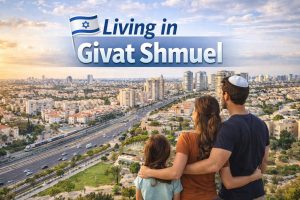 Living in Givat Shmuel appeals to buyers seeking a suburban environment close to Tel Aviv without Tel Aviv pricing. The city sits near Bar-Ilan University, the Givat Shmuel Interchange, and major employment hubs in central Israel. It is dense, well-planned, and known for efficient municipal services. Buyers who prioritise access to education, religious infrastructure, and community institutions often consider living in Givat Shmuel as a balanced option. The city’s development model has focused on mid-rise and high-rise residential clusters rather than small subdivisions, making it different from neighbouring Givatayim or Ramat Gan.
Key data points
- Population: roughly 30,000–31,000 residents.
- Location: east of Ramat Gan, near Highway 4.
- Price level: significantly lower than Givatayim/Tel Aviv but higher than Petah Tikva.
- Housing stock: mostly modern buildings built 1990s–2020s, with a continuing wave of redevelopment.
- Demand drivers: Bar-Ilan University, proximity to major highways, religious communities, and young-family demographics.
Practical implications
Residents benefit from short commutes to Tel Aviv while avoiding Tel Aviv traffic congestion for most local errands. Buyers who work in central Israel gain mobility due to multiple transportation corridors. Families benefit from a school system with a strong reputation and consistent municipal investment. The density level means fewer standalone houses but greater availability of amenities within walking distance.
Examples relevant to Israel
A couple priced out of Ramat Gan often finds that living in Givat Shmuel gives them similar commute times at a substantially lower entry point. Young religious families moving from Jerusalem frequently choose this city for its mix of community life and employment access in the centre. Students at Bar-Ilan often rent here rather than in Tel Aviv due to cost differences.
Prices, Affordability & Market Data
Explanation
Housing prices in Givat Shmuel have risen steadily but remain more accessible than adjacent municipalities considered “inner-ring Tel Aviv”. Many new projects cater to families rather than singles, shaping the city’s price per room and price per metre. Affordability remains relative: the city is not cheap, but it offers better value than the Tel Aviv region for comparable living standards.
Key data points
- Second-hand 3-room apartments are increasingly sought after by olim looking to settle in the area. ₪2.3M–₪2.7M.
- New 4-room units in modern towers: ₪3.2M–₪3.8M.
- Luxury penthouses: ₪5M+.
- Long-term rental prices: ₪5,500–₪7,500 for 3–4 rooms depending on building age.
Actual numbers vary with floor height, parking, warehouse storage, lift availability, and the project’s urban renewal status.
Practical implications
Families seeking 4 rooms may need to compromise on building age. Younger buildings command a premium due to safer construction standards, stronger earthquake compliance, and underground parking. Investors considering living in Givat Shmuel Israel or purchasing rental units face high demand from students and young families, ensuring reduced vacancy risk. However, yields are modest—typically 2.2–2.8%—and are unlikely to improve unless rental legislation changes.
Examples relevant to Israel
A buyer comparing Petah Tikva and Givat Shmuel may find prices 8–12% higher in Givat Shmuel but with better resale potential. Someone choosing between Ramat Gan and Givat Shmuel may find savings of 15–20% for similar floor plans. Urban renewal schemes in the area, similar to many TAMA 38 projects across Israel, have raised prices for post-renovation buildings.
Demographics, Community & Lifestyle
Explanation
Givat Shmuel’s demographic mix is distinct: a blend of religious-Zionist families, young professionals working in the centre, university students, and a significant English-speaking population. This combination shapes local culture, education, activity levels, and social expectations. Many residents prioritise education quality, community cohesion, and moderate religious orientation.
Key data points
- Religious-Zionist majority, but with secular and traditional minorities.
- High rate of university students living off-campus.
- Large number of young families with children under 15.
- Multiple synagogues representing different community subgroups.
- Substantial Anglo presence—particularly from the US, UK, and South Africa.
Practical implications
For families planning on living in Givat Shmuel, the city offers community life without heavy ideological segmentation. Many residents choose the city due to its stable educational environment: local schools consistently outperform national averages. Parks and playgrounds are dense, which reduces the need for car dependency. For students, rentals are typically affordable compared with Tel Aviv but within walking distance of the university.
Examples relevant to Israel
Religious families leaving Jerusalem often select Givat Shmuel to maintain community structure while gaining access to central Israel job markets. English-speaking families unable to enter the Tel Aviv public school system comfortably often find smoother integration here. University students who previously lived in Ramat Gan frequently migrate to Givat Shmuel due to better apartment conditions and lower noise levels.
Risks, Limitations & Buyer Considerations
Explanation Living in Givat Shmuel
Although living in Givat Shmuel is attractive to many segments, the city comes with structural limitations: high density, limited parking in older areas, and pressure on public infrastructure. Buyers need to assess construction quality, especially in buildings from the 1980s–1990s, which may not meet modern seismic standards. Urban renewal projects in the area improve long-term investment prospects but may create years of construction noise and traffic, making it a challenging destination for families considering life in Israel.
Key data points
- Many neighbourhoods are under TAMA 38 or Pinui-Binui proposals.
- Traffic congestion has increased with population growth.
- Parking shortages persist in older streets, which can be a concern for families and olim moving to Givat Shmuel.
- Few opportunities for detached homes—almost exclusively apartments.
- High share of students means some buildings experience tenant turnover and noise, depending on location.
Practical implications
A family evaluating older buildings may need engineering inspections due to Israel’s mixed regulatory history before 1990s building codes tightened, especially in neighborhoods popular with anglos. Investors considering rentals should be cautious with areas adjacent to Bar-Ilan, where short-term tenant churn is common. Buyers expecting quiet suburban living may find the city’s density challenging. The reliance on apartment towers means homeowners’ association management quality varies, influencing maintenance fees and property condition.
Examples relevant to Israel
Older buildings throughout the Tel Aviv region have a known pattern of suboptimal waterproofing, obsolete plumbing, and inadequate insulation. Givat Shmuel shares some of these issues in pre-2000 stock. Pinui-Binui zones near main roads resemble similar redevelopment processes in cities like Yehud or Kiryat Ono, bringing investment potential but temporary disruption.
Strategic Recommendations
Explanation
Buyers who want the advantages of living in Givat Shmuel should approach the market with a structured decision framework. The city is well-suited for families, religious communities, and professionals who require central access. However, the best outcomes come from selecting the right building type, evaluating long-term infrastructure, and understanding the city’s demographic rhythms, which are influenced by the influx of olim.
Key data points
- Premium areas: newer towers near Givat Shmuel Park and central commercial zones.
- Better value: older buildings slightly further from core roads, targeted for future TAMA 38.
- Best rental demand: streets within walking distance of Bar-Ilan but not directly adjacent to nightlife areas.
- Strongest resale potential: large family-sized flats (4–5 rooms) in modern buildings.
Practical implications
A family purchasing for long-term residence should consider the school catchment. Proximity to parks significantly influences child-friendly living. Investors should model yield realistically; rental income will rarely exceed modest numbers due to strong owner-occupier demand. Buyers sensitive to noise should avoid streets with ongoing construction or heavy bus routes.
Examples relevant to Israel
Families choosing between Givat Shmuel and Kiryat Ono often select the former for community infrastructure and the latter for price stability. Buyers comparing Givat Shmuel and Tel Aviv usually select Givat Shmuel for affordability and educational quality. Pinui-Binui redevelopments similar to those in Ramat Gan can significantly improve long-term value for older buildings if one is prepared to wait through the construction cycle.
Transportation, Mobility & Commute Patterns
Explanation
Mobility plays a major role in evaluating whether living in Givat Shmuel fits a buyer’s lifestyle. The city lacks a train station, yet its geographic position compensates with strong road access and dependable bus routes. The proximity to Highway 4 and Jabotinsky Road creates efficient east–west and north–south commuter pathways. Despite its small size, the city experiences peak-hour congestion because most residents work in the Tel Aviv metropolitan area.
Key data points
- No railway station yet; nearest stations: Bnei Brak, Petah Tikva, and Tel Aviv University.
- Bus routes operate frequently to Tel Aviv, Ramat Gan, and Petah Tikva.
- Average car commute to central Tel Aviv: 18–30 minutes depending on traffic.
- Growing use of electric scooters and bicycles for short distances.
Practical implications
Residents who depend on public transport must expect crowding during university semesters. Drivers face bottlenecks at central junctions, particularly in the morning. The lack of a future Metro station keeps housing prices lower than cities aligned directly with the Metro plan. Buyers weighing whether living in Givat Shmuel Israel works long-term should assess daily commute patterns realistically.
Examples relevant to Israel
This situation mirrors cities like Kiryat Ono—excellent location, strong demand, but continued reliance on road transport until future rail expansions materialise.
Education Quality & Local Institutions
Explanation
A major appeal of living in Givat Shmuel is its education network, which consistently outperforms national benchmarks. Families prioritising educational continuity, religious-Zionist frameworks, and stable administration find the city’s system predictable and academically solid.
Key data points
- High Bagrut eligibility rates.
- Strong religious-Zionist school clusters with established reputations.
- Extensive after-school chugim (extracurricular programmes).
- Proximity to Bar-Ilan University enriches academic culture.
Practical implications
Parents moving from larger cities such as Jerusalem or Beit Shemesh often find Givat Shmuel’s schools easier to navigate. The municipal emphasis on enrichment programmes benefits families seeking structured after-school activity, enhancing the appeal of life in Israel for new residents. Flats located near primary schools command higher premiums because walking-distance access matters in dense cities.
Examples relevant to Israel
This educational performance resembles that of Givatayim, where strong school results drive residential competition.
Urban Planning, Density & Future Development
Explanation
The city’s urban planning approach has prioritised vertical growth over horizontal sprawl, reflecting a response to the needs of its diverse demographic, including many olim. For those considering living in Givat Shmuel, this creates predictable density levels but limits the availability of ground-floor garden apartments or private homes.
Key data points
- The majority of recent construction consists of 10–20 storey towers, catering to the growing demand from olim and young families.
- Multiple Pinui-Binui (evacuation/rebuild) projects under discussion.
- Green spaces preserved but not expanded at the pace of residential growth.
- Commercial infrastructure concentrated in a few dense clusters.
Practical implications
Buyers should expect noise and construction disruption for years as urban renewal accelerates. Future value appreciation is likely in zones undergoing redevelopment, especially those that connect well with Bar-Ilan University. Families seeking quieter suburban layouts may prefer neighbourhoods at the city’s edges toward Petah Tikva.
Examples relevant to Israel
This development trajectory resembles Ramat Gan’s shift to high-rise living and urban densification to meet demand.
Rental Market Behaviour & Investor Profile
Explanation
The rental market in Givat Shmuel is shaped by steady university-driven demand and by families seeking mid-term rental stability while saving for a purchase. This limits vacancy but also suppresses rental yields.
Key data points
- Yields average 2.2–2.8%, making it a viable investment destination for those looking to connect with the local community.
- Student-driven demand peaks at the start of academic years.
- Smaller units rent faster than larger ones.
- Turnover is higher near Bar-Ilan University.
Practical implications
Investors considering Living in Givat Shmuel has become a desirable option for many olim looking for community and connection. narratives for their decision-making should expect stable occupancy but modest profit. Families renting longer-term often compete for newer buildings, driving up rent for modern units. Investors buying 3-room apartments gain the strongest liquidity.
Examples relevant to Israel
Investor patterns mimic areas around Hebrew University (Jerusalem) and Technion (Haifa), where academic institutions stabilise demand but not yield.
Cultural Life, Parks & Public Spaces
Explanation
Despite its density, Givat Shmuel maintains a well-utilised network of public parks and community centres. Many residents choose living in Givat Shmuel because it offers accessible recreation without needing a large-city footprint.
Key data points
- Major parks: Givat Shmuel Park, playground clusters, sports courts.
- Community events: holiday festivals, youth programmes, municipal classes.
- High participation in local sports clubs and after-school activities.
Practical implications
Families benefit from walkable public spaces. Many neighbourhoods have pocket parks within a two-minute walk, pushing parents to prioritise proximity during apartment selection. Cultural life is modest compared with Tel Aviv, but the short distance to major entertainment hubs compensates.
Examples relevant to Israel
The model resembles Modi’in, where parks and recreational infrastructure shape family decision-making more than nightlife.
Long-Term Value Outlook & Market Stability
Explanation
The long-term value trajectory of living in Givat Shmuel is shaped by demand stability, demographic consistency, and limited land reserves. The city is unlikely to experience extreme price volatility due to its strong family-oriented population and ongoing urban renewal.
Key data points
- Consistent year-on-year price growth over the past decade.
- No major new land releases expected.
- Strong demand from religious-Zionist families ensures tight supply.
Practical implications
Buyers seeking a stable long-term residence can expect predictable appreciation rather than speculative spikes, particularly in areas like Givat Shmuel that are popular among olim. Investors focusing on capital preservation—rather than high yield—may find the market suitable. The city’s reliance on central-Israel employment hubs makes it resilient to regional economic fluctuations.
Examples relevant to Israel
Price stability mirrors cities like Kiryat Ono and Givatayim, where limited supply and high-quality demand create upward pressure regardless of cycles.
Conclusion
Living in Givat Shmuel offers a structured choice for buyers who want central Israel access, strong community life, and a balanced price level compared with Tel Aviv and Ramat Gan. The city’s demographic profile, educational strength, and modern housing stock make it attractive to young families and religious-Zionist households, while students provide steady rental demand, contributing to the vibrant life in Israel. The main challenges are density, infrastructure pressure, and limited detached housing options, which affect both locals and new immigrants. With clear due diligence—evaluating building quality, assessing urban renewal impacts, and selecting neighbourhoods carefully—buyers can find reliable long-term value. For many households, living in Givat Shmuel Israel delivers a pragmatic middle ground between urban access and suburban stability.
Israel Homes Is a Guide to Finding, Understanding, and Buying Property in Israel