
Guide to How to Choose an Israeli Bank for Your Mortgage
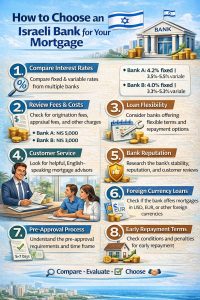 Choosing a mortgage in Israel is not a consumer-friendly process. Banks hold most of the power, pricing is opaque, and many buyers—especially Anglos and foreign residents—misjudge risk. This guide explains how to choose an Israeli bank for your mortgage in a way that survives interest-rate shocks, regulatory constraints, and long loan tenures typical in Israel. If your assumptions are wrong, the cost is not marginal; it can reach hundreds of thousands of shekels over the life of the loan.
Overview & Key Concepts how to choose an Israeli bank for your mortgage
Explanation
Understanding how to choose an Israeli bank for your mortgage starts with accepting one fact: Israeli mortgages are structurally different from those in the US, UK, or Europe. Loans are almost always variable-rate hybrids, indexed to inflation, and renegotiated multiple times. No Israeli bank is “good” or “bad” in absolute terms—only suitable or unsuitable for your specific risk profile.
Banks are regulated by the Bank of Israel, but competition is limited. Pricing differences come from internal risk scoring, not advertised rates, especially for new immigrants. Therefore, learning how to choose an Israeli bank for your mortgage is primarily about leverage, structure, and long-term exposure—not brand loyalty.
Key Data Points
- Typical mortgage term: 20–30 years
- Maximum Loan-to-Value (LTV):
- First home: up to 75%
- Second home: up to 70%
- Investment property: up to 50%
- At least 33% of the mortgage must be non-variable (as per Bank of Israel rules)
- CPI-linked tracks remain common, unlike most Western markets, which can affect foreign currencies.
These constraints shape how to choose an Israeli bank for your mortgage more than headline interest rates.
Practical Implications
If you focus only on the lowest initial rate, you will likely lose. Banks use teaser pricing on one track while overpricing others. A correct approach to take out a mortgage involves consulting a mortgage broker. how to choose an Israeli bank for your mortgage means analysing the entire blend and its behaviour under inflation and rate hikes.
Examples Relevant to Israel
An oleh from the UK choosing a mortgage based purely on today’s prime discount may underestimate CPI exposure. When inflation rises, repayments jump even if the base rate does not. This is a classic failure to understand how to choose an Israeli bank for your mortgage in local conditions.
Pricing, Costs & Financial Breakdown
Explanation
Mortgage pricing in Israel is deliberately fragmented. Every mortgage is a bundle of tracks: prime, fixed unlinked, fixed CPI-linked, variable CPI-linked, and sometimes foreign-currency-linked. Understanding how to choose an Israeli bank for your mortgage requires dissecting each component, not averaging the rate.
Banks in Israel price risk asymmetrically, affecting your ability to get a mortgage. They discount tracks they expect you to overuse and overprice those you ignore, which can affect how you get a mortgage in Israel. The total cost is only visible when projected across 20–30 years.
Key Data Points
- Prime rate = Bank of Israel rate + 1.5%
- CPI long-term average (Israel): ~2% annually, but volatile
- Early repayment penalties apply mainly to fixed tracks
- Legal, appraisal, and registration costs typically add 1.5%–2.5% of loan value
When calculating the costs of getting a mortgage, consider the type of mortgage you choose. how to choose an Israeli bank for your mortgage, include all ancillary costs, not just interest.
Practical Implications
Two banks offering the “same” rate can differ by hundreds of thousands of shekels in total repayment. A bank with slightly higher rates but more flexible restructuring terms may be safer for new immigrants. This is often ignored when people think they know how to choose an Israeli bank for your mortgage.
Examples Relevant to Israel
A buyer in Be’er Sheva might receive a cheaper offer from a smaller bank, but with stricter penalty clauses. In a market where refinancing is common, this can be a strategic mistake in the mortgage process. how to choose an Israeli bank for your mortgage.
Risks, Limitations & Critical Notes
Explanation
The biggest error in how to choose an Israeli bank for your mortgage is assuming stability. Israeli interest rates and inflation are historically volatile, impacting decisions for new immigrants. Mortgages that look affordable today may not be in five years.
Banks also reserve the right to reassess risk at refinancing. Your future salary, residency status, or rental income may not be treated the same way later.
Key Data Points
- CPI spikes above 4% have occurred multiple times in the past 20 years
- Prime rate doubled within short periods more than once
- Variable-rate exposure above 50% significantly increases repayment volatility in the mortgage process.
Ignoring these risks means you do not actually understand how to choose an Israeli bank for your mortgage.
Practical Implications
If more than half your mortgage is exposed to CPI or prime, you are speculating on macroeconomics. That may be intentional—but it must be conscious. A defensible strategy for how to choose an Israeli bank for your mortgage balances flexibility with insulation from shocks.
Examples Relevant to Israel
Foreign buyers often over-allocate to CPI-linked fixed tracks because the initial rate looks low when trying to get a mortgage in Israel. Over 25 years, this can outperform inflation in the wrong direction. This is a recurring failure in how to choose an Israeli bank for your mortgage.
Comparison & Practical Recommendations
Explanation how to choose an Israeli bank for your mortgage
No single bank is universally best for getting a mortgage in Israel. Instead, each major bank has tendencies. Understanding these patterns helps refine how to choose an Israeli bank for your mortgage, but never replaces negotiation.
Key Data Points (General Tendencies)
- Bank Leumi: Conservative underwriting, stable long-term pricing
- Bank Hapoalim: Strong negotiating room, aggressive on prime rates for those looking to take out a mortgage.
- Mizrahi Tefahot: Mortgage-focused, competitive blends for foreign buyers looking to get a mortgage.
- Discount Bank: Pricing swings, depends heavily on profile
These are patterns, not guarantees. Blindly following them is not advisable for those looking to buy a home in Israel. how to choose an Israeli bank for your mortgage.
Practical Implications
You must obtain written offers from at least three banks and force them to compete on identical structures, which is crucial for olim. Without this, you are guessing. A correct process is central to how to choose an Israeli bank for your mortgage.
Examples Relevant to Israel
A high-income couple in Tel Aviv may benefit from aggressive prime discounts, while a single foreign investor in Netanya may prioritize underwriting flexibility when purchasing property in Israel. The “best bank” changes with context—this is the core logic of working with a mortgage broker. how to choose an Israeli bank for your mortgage.
Buyer / Homeowner Checklist
Explanation
A checklist prevents emotional or time-pressure decisions. Most mortgage mistakes occur because buyers rush. Discipline is non-negotiable in how to choose an Israeli bank for your mortgage.
Key Data Points
Before signing, confirm:
- Full blended APR over loan life
- CPI sensitivity under high-inflation scenarios
- Early repayment penalties by track
- Refinancing conditions and documentation requirements can vary significantly for olim.
If any of these are unclear, you do not yet know how to choose an Israeli bank for your mortgage.
Practical Implications
Treat the mortgage like a long-term financial product, not a hurdle to get keys. The wrong structure can limit mobility, refinancing, and cash flow for decades. This is the final test of whether you truly understand the nuances of taking out a mortgage in Israel. how to choose an Israeli bank for your mortgage.
Examples Relevant to Israel
Many homeowners discover too late that their “cheap” mortgage is expensive to exit. A proper checklist would have flagged this early. That is the difference between guessing and actually knowing how to choose an Israeli bank for your mortgage.
Regulation, Bank of Israel Rules & Structural Constraints
Explanation
Any serious analysis of how to choose an Israeli bank for your mortgage must start with regulation. Israeli banks do not design mortgages freely; they operate under binding directives from the Bank of Israel. These rules limit risk at the system level but transfer volatility to borrowers.
Key restrictions—such as caps on variable-rate exposure and LTV ceilings—mean banks optimise within constraints, not beyond them. Understanding these limits clarifies why banks price similarly and where negotiation actually works.
Practical Implications
If two banks offer near-identical structures, regulation—not collusion—is usually the reason. Knowing this prevents wasted negotiation effort and helps you focus on areas where how to choose an Israeli bank for your mortgage still allows leverage: track mix, penalties, and future flexibility.
Residency Status, Citizenship & Risk Scoring
Explanation
Residency status materially affects how to choose an Israeli bank for your mortgage. Israeli citizens, permanent residents, temporary residents, and foreign nationals are each scored differently—even with identical income and assets.
Banks apply higher internal risk weights to non-residents, often tightening LTV limits, demanding higher equity, or pricing conservatively across all tracks.
Practical Implications
A foreign buyer comparing banks without accounting for residency differences is not comparing like with like. The correct approach to how to choose an Israeli bank for your mortgage is to compare how each bank treats your status, not how they treat locals.
Income Type, Currency & Stability Assessment
Explanation
Israeli banks do not assess income neutrally. Local salaried income in shekels is preferred. Foreign income, self-employment, dividends, or rental income are discounted—sometimes heavily—when deciding how to choose an Israeli bank for your mortgage.
Currency mismatch is a hidden risk. Income in USD or GBP does not automatically hedge a shekel-denominated mortgage.
Practical Implications
If your income is foreign or irregular, some banks will quietly price that risk through worse terms rather than explicit rejection. Choosing the wrong bank here undermines how to choose an Israeli bank for your mortgage before negotiations even begin.
Refinancing Strategy & Exit Optionality
Explanation
Most borrowers focus on entry conditions and ignore exit mechanics. This is a structural error in how to choose an Israeli bank for your mortgage. Refinancing in Israel is common, but not equally easy across banks or mortgage structures.
Penalty formulas, documentation requirements, and internal approval thresholds vary widely.
Practical Implications
A bank with slightly higher rates but lenient refinancing rules may be cheaper long-term for your type of mortgage. A correct framework for how to choose an Israeli bank for your mortgage values optionality over marginal headline discounts.
Negotiation Dynamics & Timing
Explanation
Negotiation is not optional in the mortgage process. how to choose an Israeli bank for your mortgage; it is assumed. Banks expect pushback and initial offers are deliberately padded.
Timing matters. Quarter-end, rate-change windows, and internal campaign periods affect pricing more than most borrowers realise.
Practical Implications
Approaching banks in Israel sequentially weakens leverage when trying to get a mortgage. The correct process for how to choose an Israeli bank for your mortgage is parallel bidding with identical structures, forcing banks to compete under time pressure.
Psychological Biases & Common Decision Errors
Explanation
The final barrier in the mortgage process can often be the negotiation with banks. how to choose an Israeli bank for your mortgage Understanding the market is cognitive, not financial, especially for those new to home in Israel. Buyers anchor on monthly payment, underestimate tail risk, and overweight short-term affordability.
Banks design offers to exploit these biases, especially CPI-linked and variable tracks.
Practical Implications
If you cannot explain why each track exists in your mortgage, you are relying on trust rather than analysis. A defensible approach to how to choose an Israeli bank for your mortgage A bank treats the loan as a long-duration risk instrument, not a lifestyle enabler for olim.
Final Position how to choose an Israeli bank for your mortgage
There is no shortcut to how to choose an Israeli bank for your mortgage. The system rewards preparation and punishes assumptions. If you cannot model worst-case scenarios and negotiate across banks in Israel, you are not choosing—you are accepting. In Israeli mortgage markets, acceptance is expensive.
Israel Homes Is a Guide to Finding, Understanding, and Buying Property in Israel