
Living in Zichron Yaakov: Anglo Appeal and Market Insights
Overview & Key Characteristics
Explanation Livingin Zichron Yaakov
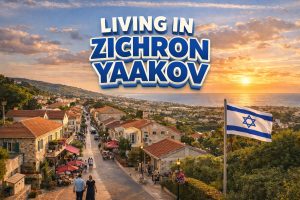 Living in Zichron Yaakov is often framed as a middle-ground solution for households seeking a quieter lifestyle without disengaging entirely from Israel’s economic centres. Positioned on the Carmel ridge above the coastal plain, Zichron Yaakov provides a blend of rural charm, historical weight, and access to employment hubs such as Haifa, Caesarea, and Tel Aviv. Many Anglos looking for a more consistent quality of life than large cities offer—yet unwilling to move too far north—select the town because it delivers an unusual balance: quaint streets, vineyards, sea views, and functional commuting options.
Zichron Yaakov is not merely another scenic settlement; it is one of the earliest modern Jewish communities in the country and maintains a coherent design ethos around its historic centre. This physical identity shapes the experience of living in Zichron Yaakov, especially for those who value stable neighbourhood character and predictable zoning.
Key data points
- Population: roughly 25,000–26,000.
- Established neighbourhoods such as HaMoshava, Givat Eden, HaGiborei, and Ramat Nesher are often compared to Zichron, known for its rich history and community spirit.
- Commute times: ~15 minutes to Caesarea, ~25 minutes to Haifa, ~45–55 minutes to Tel Aviv (traffic-dependent).
- Schooling: mix of mamlachti, mamlachti dati, Tali, and several private options.
Practical implications
The core implication is that living in Zichron Yaakov reduces strain for buyers seeking calm residential patterns while maintaining mobility to workplaces. Residents typically report fewer day-to-day disturbances compared with denser Israeli cities, enjoying the tranquility that Zichron offers. For parents, schools and youth movements operate as stabilising frameworks that help integrate new immigrants quickly.
However, anyone considering living in Zichron Yaakov must account for its strong community expectations. Volunteer culture is widespread, and participation tends to be a normative demand rather than optional. Buyers who prefer anonymity may interpret this as pressure.
Examples relevant to Israel
- Hybrid workers splitting the week between Tel Aviv and home find living in Zichron Yaakov more manageable than commuting from the Galilee or Jerusalem suburbs.
- Families relocating from Anglo-heavy areas such as Raanana, Beit Shemesh, and Efrat often select Zichron to downsize stress while keeping schooling quality high.
- Retirees seeking moderate climate and geographical beauty often see Zichron as a less expensive alternative to Haifa’s Carmel neighbourhoods.
Prices, Affordability & Market Data
Explanation
Property values have risen steadily as demand for living in Zichron Yaakov accelerates, especially among Anglos. Limited land availability and reluctance to expand outwardly preserve prices at levels above many comparable northern towns. Buyers must understand that “affordable” is relative: compared with Tel Aviv, prices appear reasonable; compared with Yokneam, Pardes Hanna, or Kiryat Tivon, Zichron is materially more expensive.
The price gradient across neighbourhoods is pronounced. Proximity to the historic pedestrian street, sea views, and low-density streets yield premium pricing. Homes further south in newer developments command lower but still elevated figures, while Zichron offers a variety of housing options for families.
Key data points
- 4–5 room flats: roughly 2.3m–3.5m NIS depending on age and location.
- Small garden apartments: 3m–4.3m NIS.
- Villas: 4.5m–10m NIS+, with sea-view homes exceeding this range, particularly near the Carmel Winery.
- New builds remain limited, maintaining supply constraints.
Practical implications living in Zichron Yaakov
Anyone evaluating living in Zichron Yaakov must understand the constraints placed by limited construction starts. Rarely are large developments approved, meaning buyers face a semi-fixed inventory that creates upward price pressure. Investors analysing rental yields should expect relatively modest returns; the town is not a prime investor market.
Households requiring mortgage leverage should prepare for valuations that may come in slightly lower than optimistic asking prices. Sellers often benchmark their expectations against Tel Aviv or Caesarea valuations, creating gaps between market reality and seller psychology.
Examples relevant to Israel
- Buyers who sold in Raanana or Herzliya often purchase with cash or relatively low leverage, contributing to competitive offer environments.
- Young families coming from Haifa seeking larger space sometimes choose Zichron despite a higher purchase price because the long-term living conditions outweigh added cost.
- Demand from international buyers during peak aliyah periods (e.g., 2020–2023) temporarily inflated prices, a trend similar to Beit Shemesh and Modi’in, with Zichron being a favored destination for new olim.
Demographics, Community & Lifestyle
Explanation
Living in Zichron Yaakov is shaped heavily by its demographic diversity. While the Anglo community is visible, it does not dominate the town. Instead, Zichron consists of secular, traditional, religious, and mixed families who collectively maintain a socially moderate atmosphere. This diversity acts as a buffer against the political polarisation seen in some communities.
Lifestyle expectations are distinct: outdoor spaces, hiking trails, local vineyards, and cultural events are central to social life. Parents raising children in Zichron often describe it as a safe environment with predictable routines, strong youth movements, and structured communal norms.
Key data points
- Anglo residents constitute ~15–20% of certain neighbourhoods.
- A high proportion of residents hold academic or professional degrees.
- Age distribution skews family-centred, but retirees form a growing segment.
Practical implications
For Anglos, living in Zichron Yaakov offers smoother integration compared with towns that lack international populations. However, it is not Beit Shemesh or Efrat; English is not the default social language, and cultural adaptation remains necessary for olim in Zichron.
Buyers prioritising religious infrastructure should note that while there are multiple synagogues, the town does not present as a fully religious enclave. Mixed environments can benefit some families but frustrate others expecting a denser religious ecosystem.
Examples relevant to Israel
- Families arriving from the UK or US often report quicker integration than in purely Hebrew-speaking northern towns due to broader cultural diversity.
- Secular households relocating from Tel Aviv appreciate the quieter evenings and reduced noise.
- Religious families coming from Ma’ale Adumim or Givat Shmuel may need to adjust expectations surrounding school networks and community intensity.
Risks, Limitations & Buyer Considerations
Explanation
Living in Zichron Yaakov presents advantages but also non-trivial limitations. Buyers must not treat the town through a sentimental lens. Geographic beauty does not eliminate infrastructure bottlenecks, ageing housing stock, or transportation constraints. Risk comes from assuming the lifestyle optics outweigh real, measurable costs.
Key data points
- Public transport remains insufficient for those not using private cars.
- Traffic congestion at the Netanya–Haifa corridor can disrupt commuting.
- Older homes may require significant renovation due to humidity, outdated plumbing, or insufficient insulation.
- Earthquake preparedness varies across neighbourhoods and building ages.
Practical implications
Households budgeting for living in Zichron Yaakov should allocate realistic renovation allowances—older villas frequently require complete system overhauls. Buyers seeking new construction may face frustration due to limited supply. Those relying on public transport will experience reduced mobility.
A recurring mistake among Anglos is assuming that Zichron is uniformly walkable. While the pedestrian centre offers this benefit, newer neighbourhoods are car-dependent. Buyers arriving without inspecting each neighbourhood’s topography risk misalignment.
Examples relevant to Israel
- Engineering surveys in Carmel-ridge towns often reveal moisture penetration issues, a pattern consistent in Zichron homes built before the early 2000s.
- Similar to Ramat HaSharon or Hod Hasharon, competition for well-located family homes is intense, meaning buyers often extend beyond their initial preferred streets.
- Overestimating commute feasibility has led some households to relocate again within 3–5 years.
Strategic Recommendations
Explanation
Making a rational decision about living in Zichron Yaakov requires structured evaluation rather than emotional reaction to scenery or anecdotal reports from current residents. Buyers should sequence their decision-making: neighbourhood fit, transport viability, budget alignment, renovation feasibility, and long-term community expectations.
Key data points
- Neighbourhoods vary significantly by housing stock, elevation, and community identity, with Zichron offering a unique blend of historical charm and modern amenities.
- School placement depends on capacity and zone, not buyer preference.
- Sea-view premiums can inflate prices by 15–40% relative to similar homes without the view.
Practical implications
Conduct neighbourhood-level comparisons rather than assessing Zichron as a single unit. For example, buyers wanting dense Anglo presence focus on HaMoshava and Givat Eden. Households wanting lower prices explore Ramat Nesher or areas bordering the industrial zone.
Run numbers using realistic maintenance costs for hillside towns. For many buyers, the difference between living in Zichron Yaakov and moving to cheaper alternatives lies not in purchase price alone but in long-term system replacements, slope-related structural maintenance, and landscaping costs.
Examples relevant to Israel
- A family comparing Zichron with Pardes Hanna often concludes that Zichron provides a more stable long-term value but requires higher upfront investment.
- Buyers choosing between Haifa and Zichron typically prioritise schooling and quieter suburban structure, with Zichron offering a strong sense of community.
- Those deciding between Caesarea and Zichron often shift toward Zichron due to stronger community cohesion at lower cost, making it an attractive option for new olim.
Long-Term Appreciation Outlook living in Zichron Yaakov
Explanation
Evaluating long-term value matters when considering living in Zichron Yaakov. Prices have risen for structural—not speculative—reasons: stable demand, constrained supply, desirable geography, and a predictable municipal profile.
Key data points
- Supply expansion rate remains low.
- Migration inflows from central Israel continue, especially among Anglos.
- Infrastructure improvements (such as road expansions north–south) influence medium-term pricing.
Practical implications
Buyers expecting rapid appreciation similar to Tel Aviv or Jerusalem may be disappointed. Zichron behaves more like a mature suburban market: stable, consistent, and slow to decline. The main volatility risk lies in macroeconomic changes, not local oversupply.
Examples relevant to Israel
- The appreciation trajectory resembles Ramat HaNadiv and Kiryat Tivon more than Modi’in or Be’er Sheva.
- Anglo relocation patterns are relatively price-insensitive, supporting stability even during market downturns.
Schooling, Youth Frameworks & Integration Patterns
Explanation
Education forms a core part of the experience of living in Zichron Yaakov. Parents frequently cite education quality as a decisive purchase factor.
Key data points
- A mix of secular, dati, and pluralistic frameworks.
- Youth movements (e.g., Tzofim, Bnei Akiva) serve as major social anchors.
- Special education programmes available through regional networks.
Practical implications
School zoning limits flexibility. New residents assuming they can choose any school without municipal approval often encounter obstacles. Youth movements greatly aid immigrant children’s integration but require parental buy-in and transportation at times.
Examples relevant to Israel
- Anglo families moving from Efrat or Beit Shemesh appreciate strong outdoor-centred programming.
- Children entering mid-year may experience delays in placement due to capacity limits.
Transportation, Commuting & Infrastructure
Explanation
Transport strongly influences the practicality of living in Zichron Yaakov. Car dependency is the norm.
Key data points
- Nearest train stations: Binyamina and Caesarea.
- Limited bus frequency within the town.
- Road 4 and Road 2 provide north–south access but suffer rush-hour congestion.
Practical implications
Commuters to Tel Aviv must accept inconsistency, especially when considering the benefits of living near Zichron’s vibrant community. Buyers planning daily travel should trial the commute before committing. Households with teenagers may require an additional vehicle due to town layout.
Examples relevant to Israel
- Similar transport challenges appear in Kiryat Ono, Hod Hasharon, and Shoham, but Zichron’s distance from Tel Aviv amplifies the impact.
Housing Types & Renovation Realities
Explanation
Housing stock varies widely, affecting suitability for different households considering living in Zichron Yaakov.
Key data points
- Early 20th-century stone houses in the Moshava.
- 1980s–2000s villas and duplexes.
- Limited new projects.
Practical implications
Older homes require structural reviews: retaining walls, damp, and insulation issues are common. Engineering surveys are essential, particularly for properties near the historic sites of Baron Edmond de Rothschild’s investments. Buyers must not assume that hillside homes offer stable foundations without reinforcement documentation.
Examples relevant to Israel
- Similar structural patterns appear in Haifa’s Carmel, where slope-built homes require constant maintenance.
Employment Patterns & Economic Connectivity
Explanation
Employment realities shape the viability of living in Zichron Yaakov for many households. Because the town is not a major employment hub, residents depend on regional job centres such as Haifa, Caesarea, Yokneam, and Tel Aviv. The diversification of Israel’s workforce—particularly hybrid and remote roles—has altered the calculation for buyers, making Zichron more feasible for professions once limited to central Israel.
Key data points
- High proportion of residents in tech, academia, education, and healthcare, with many drawn to Zichron due to its proximity to the Carmel Winery.
- Employers in Haifa’s high-tech clusters and Caesarea’s industrial zones are major job anchors.
- Remote and hybrid work adoption among Anglos is notably higher than the national average.
Practical implications
Those living in Zichron Yaakov with full-time jobs in Tel Aviv face unpredictable commute times. Hybrid workers fare better. Households should budget for dual-car ownership if both adults work outside the immediate region.
Examples relevant to Israel
- Engineers split between Haifa offices and home choose Zichron due to manageable half-week commutes.
- English-speaking professionals working for international companies often relocate because remote work reduces reliance on Tel Aviv.
Environmental Factors & Geographic Realities
Explanation
The town’s hillside geography provides beauty but also logistical constraints. Living in Zichron Yaakov entails adjustment to elevation changes, microclimates, and weather patterns influenced by proximity to the Mediterranean.
Key data points
- Higher humidity than inland areas; cooler evenings compared with the coastal plain.
- Homes on the western ridge are exposed to sea winds; eastern edges are more sheltered.
- Increased risk of damp in lower-lying neighbourhoods.
Practical implications
Buyers often underestimate the maintenance impact of humidity on façades, internal walls, and outdoor structures. Garden-heavy properties require irrigation planning, as Zichron sits on a ridge with inconsistent soil conditions, making local wineries a potential source of inspiration for landscaping. Wind exposure can affect outdoor living spaces.
Examples relevant to Israel
- Same damp-related issues appear in Atlit and Denya (Haifa), where sea-facing homes degrade faster without proactive maintenance.
- Elevated towns like Zichron mirror safety advantages during heatwaves compared with low-lying coastal cities.
Rental Market Dynamics & Investor Outcomes
Explanation
While the town attracts attention from domestic and foreign investors, living in Zichron Yaakov is not primarily an investor-driven market. Rental yields remain low relative to national averages due to high purchase prices and limited tenant turnover.
Key data points
- Long-term rentals dominate the market; short-term rentals face strict municipal scrutiny.
- Yields often range from 2.2%–3.2%, below those in cities such as Haifa or Be’er Sheva.
- Student demand is minimal, reducing rental churn.
Practical implications
Investors must model returns realistically. High acquisition costs and slow turnover reduce profitability. However, capital preservation remains strong due to the town’s stable demand. For renters, competition is moderate, but high-quality units are scarce.
Examples relevant to Israel
- Investors who fail to factor in low yields face similar outcomes as those in Ramat HaSharon or Raanana—high equity preservation but weak cashflow.
- Families renting temporarily after aliyah often transition to buying due to limited rental inventory.
Community Institutions, Culture & Social Integration
Explanation
Community culture is a decisive factor influencing the experience of living in Zichron Yaakov. The town’s historic identity, cultural institutions, and multigenerational families shape its social landscape.
Key data points
- Extensive cultural centres, music programmes, small theatres, and heritage sites.
- High volunteering rates in environmental, educational, and social-care programmes.
- Strong presence of wine tourism and artisanal industries.
Practical implications
Newcomers who actively engage in community institutions integrate faster. Those expecting an Anglo-majority environment may find the social culture more Israeli than anticipated, requiring adaptation to local norms around direct communication and communal responsibility.
Examples relevant to Israel
- Anglo families report smoother transitions compared with moves to cities such as Kfar Saba or Petach Tikva because Zichron’s residents display greater openness to newcomers.
- Retirees often become heavily involved in cultural volunteer networks, accelerating integration while shaping daily routines.
Conclusion living in Zichron Yaakov
Living in Zichron Yaakov offers a compelling lifestyle for households prioritising scenery, community balance, and proximity to employment hubs while avoiding the density of Israel’s major cities. It appeals strongly to Anglos due to its social diversity, moderate religious landscape, high educational standards, and walkable historic centre. However, buyers must not romanticise the experience. Transport limitations, structural maintenance, limited inventory, and price premiums impose concrete constraints.
A rigorous assessment—neighbourhood analysis, commute modelling, renovation budgeting, and community fit—determines whether living in Zichron Yaakov aligns with long-term goals. Those who approach the purchase strategically often find Zichron a stable, high-quality environment with enduring residential appeal.
Israel Homes Is a Guide to Finding, Understanding, and Buying Property in Israel