
How to Identify High-Growth Neighbourhoods in Israel
Overview & Definitions
Explanation how to identity high-growth neighbourhoods in Israel
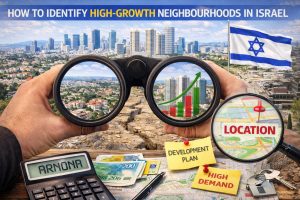 Understanding how to identify high-growth neighbourhoods in Israel requires combining data, regulatory structures, demographic shifts, and real-world development patterns. Growth in the Israeli context is not random; it responds to infrastructure, zoning approvals, transportation corridors, immigration patterns, and the policy decisions of local municipalities and national planning authorities. Buyers who fail to interrogate these layers often confuse hype with genuine long-term value.
High-growth areas generally show sustained increases in demand that outpace supply. This demand may come from natural population growth, internal migration, foreign buyers, young families seeking affordability, or investors targeting rental yield. The most common buyer mistake is assuming that “expensive equals growth,” when, in reality, the best-performing neighbourhoods in Israel over the last decade often started as overlooked and moderately priced.
Key data points
Indicators that help determine how to identify high-growth neighbourhoods in Israel include:
- Population growth exceeding 2% annually within a defined statistical area
- A ratio of job creation to housing supply above the national average
- New transport infrastructure (railway, light-rail, junction upgrades) within a 2–4 km radius
- Urban renewal approvals covering at least 15–20% of existing buildings can significantly enhance the attractiveness of a neighborhood for new apartments.
- Housing starts increasing consistently for three or more consecutive years
- Rental demand exceeding available stock by more than 10%
- Price appreciation in the neighbourhood surpassing citywide appreciation for at least eight consecutive quarters
Misreading these indicators is one of the most common buyer mistakes in Israel, especially when investors rely on marketing rather than empirical data in the real estate market.
Practical implications
If a neighbourhood shows rapid price increases without any supporting infrastructure or demographic logic, this signals speculative behaviour rather than sustainable growth. Conversely, neighborhoods with substantial public investment and municipal attention, such as Florentin, typically appreciate steadily even before projects are completed. Identifying these trends early is the core of how to identify high-growth neighbourhoods in Israel.
Examples relevant to Israel
- Kiryat HaLeom (Jerusalem): Growth driven by government complexes, the fast rail to Tel Aviv, and large-scale development pipelines.
- East Netanya urban renewal zones: Historically undervalued but now showing significant renewal activity.
- Kiryat Haim (Haifa): Rail accessibility and planned shoreline redevelopment drive long-term potential, making areas like Neve Tzedek increasingly attractive.
- Harish: A case study where infrastructure led housing demand, correcting years of mispricing.
Legal Framework & Regulations
Explanation
Anyone analysing how to identify high-growth neighbourhoods in Israel must understand the legal planning hierarchy. Growth is directly shaped by zoning rights (TABA), national planning committees, and decisions regarding transportation corridors that impact both urban and suburban developments. When buyers ignore these layers in the real estate market, they risk misjudging potential.
Israeli property law and zoning regulations determine whether land can be densified, whether towers may be constructed, and whether urban renewal can take place. These factors directly influence long-term value.
Key data points
Regulations that influence neighbourhood growth include:
- TAMA 38 cancellation and replacement programmes: Urban renewal now relies on Pinui-Binui and local authority frameworks. Cities with clear, enforceable policies (e.g., Ramat Gan, Givatayim) tend to generate more predictable growth.
- National Outline Plans (TAMA): Future transportation routes—heavy rail, light rail, metro lines—are approved within these frameworks and dramatically impact expected price increases.
- TABA (Detailed Zoning Plan): Determines permitted floors, densities, parking requirements, and commercial/residential mix.
- Minhal/Israel Land Authority policies: Lease terms, tender timing, and release of state land shape the supply side.
- Municipal tax incentives or development charges: Some cities impose high levies that delay construction, slowing growth potential.
Practical implications
When buyers fail to examine zoning approvals and regulation timelines, they often fall into the trap of assuming that municipalities will approve densification quickly. This is rarely the case. Growth only materialises when legal frameworks align with market conditions. Understanding this alignment is central to how to identify high-growth neighbourhoods in Israel.
Examples relevant to Israel
- Tel Aviv Metro Lines (M1, M2, M3): Neighbourhoods within a short walk of future stations are projected to outperform.
- Lod and Ramla: Zoning changes and redevelopment around railway lines have materially increased long-term prospects for property in Israel.
- Rejuvenation plans in Bat Yam: Legal certainty regarding renewal has led to significant investor interest.
Financial Impact & Price Factors
Explanation
A critical part of how to identify high-growth neighbourhoods in Israel is understanding how prices respond to future rather than current conditions. Buyers who focus only on present-day rental yields or resale prices overlook the strongest predictor of appreciation: the direction of public and private capital.
Key data points
Financial and market indicators include:
- Infrastructure budgets: Billions allocated to rail and road expansions often precede price rises by 2–5 years.
- Urban renewal volume: Projects that replace 1960s/1970s blocks with modern towers increase density, attract new demographics, and reshape pricing.
- Mortgage trends: Lower interest rates create demand surges in lower-cost neighbourhoods.
- Foreign buyer activity: Concentrated foreign demand can rapidly shift neighbourhood trajectories, especially in Jerusalem and coastal cities.
- Supply bottlenecks: Areas with strictly limited land availability show more stable upward trajectories.
Practical implications
A neighbourhood’s apparent affordability may hide structural constraints that will eventually force prices upward. Conversely, areas with endless potential for new construction may struggle to appreciate because supply keeps pace with demand, particularly in suburbs north of Tel Aviv. Analysts working out how to identify high-growth neighbourhoods in Israel must be wary of municipalities where developers overbuild or where the planning pipeline is saturated.
Examples relevant to Israel
- Rishon LeZion West: Benefited from proximity to railway, malls, and port employment—predictable long-term appreciation.
- Haifa’s Hadar neighbourhood: Despite low prices, buyers must recognise the oversupply risks and mixed demographic pressures.
- Ashdod 11th District: Infrastructure expansion (Highway 41 upgrades) has boosted long-term demand.
Risks, Pitfalls & Red Flags
Explanation
The process of how to identify high-growth neighbourhoods in Israel Also involves rejecting areas that present misleading signals in property value. Not every new project or government announcement translates into appreciation. Investors often misread partial information or trust developer marketing instead of analysing fundamentals.
Key data points
Common red flags in buying property include:
- Lack of population growth: If young families leave the area faster than new residents arrive, appreciation will stall.
- Urban renewal stagnation can impact property value significantly. Projects announced but not approved for years signal municipal or legal barriers that can frustrate potential buyers looking in Florentin.
- Speculative hype: When price rises rely solely on investor demand rather than employment or infrastructure.
- Weak rental market: A high vacancy rate (above 8%) suggests short-term instability.
- Environmental or planning blockages: Areas near industrial zones or military restrictions may face approval delays.
Practical implications
A neighbourhood can appear “cheap” yet remain stagnant for decades due to structural issues that no project can overcome. Buyers need to make data-led decisions rather than emotional ones. Avoiding these pitfalls is essential to mastering how to identify high-growth neighbourhoods in Israel.
Examples relevant to Israel
- Parts of Be’er Sheva Dalet/Hey: Prices are low, but oversupply and slow job creation limit potential, particularly in suburban areas with fewer amenities.
- Peripheral towns reliant on a single employer: If employment patterns shift, growth collapses.
- Marketing-driven projects without infrastructure backing: Common in the Sharon region’s fringe communities.
Buyer Checklist & Strategic Recommendations
Explanation
A structured approach clarifies how to identify high-growth neighbourhoods in Israel. Buyers should adopt a systematic due-diligence framework instead of relying on intuition or pressured sales processes.
Key data points
Checklist items include:
- Population Trends:
Verify multi-year growth using Central Bureau of Statistics (CBS) area codes. - Transport Accessibility:
Confirm whether future rail, metro, or bus rapid transit is funded, approved, or merely proposed. - Employment Clusters:
Map proximity to hospitals, tech parks, universities, and logistics centres. - Urban Renewal Certainty:
Review the number of Pinui-Binui/TAMA approvals, not just announcements. - Price vs Income Ratio:
Identify areas where prices remain below the local household income curve—indicating room for growth. - Rental Market Strength:
Track vacancy rates and rent increases. - Supply Pipeline:
Examine whether planned housing starts will oversaturate the area. - Municipal Competence:
Some cities execute projects efficiently; others stall for years, impacting the overall cost of living in the city center. - Demographic Shifts:
Look for increases in young families, students, professionals, or immigrants. - Developer Quality: The best developers focus on creating high-quality apartments that enhance community amenities.
Inconsistent project delivery undermines long-term value.
Practical implications
A buyer who follows this checklist can detect genuine high-growth opportunities early, especially in areas like Neve Tzedek. The core principle of how to identify high-growth neighbourhoods in Israel is disciplined analysis rather than trend-chasing. Neighbourhoods that score well in at least seven of the ten checklist criteria tend to outperform national averages over a ten-year horizon in the Israeli real estate.
Examples relevant to Israel
- Yokne’am: Strong employment base (tech parks), limited land, continuous demand—meets most checklist criteria.
- Modiin: Infrastructure-first planning made growth predictable long before appreciation occurred.
- South Tel Aviv renewal zones: Significant upside but require careful legal checks when considering real estate investment.
Conclusion how to identify high-growth neighbourhoods in Israel
Understanding how to identify high-growth neighbourhoods in Israel demands rigorous evaluation of demographic data, infrastructure timelines, regulatory frameworks, financial conditions, and risk indicators. Buyers who rely on assumptions or marketing narratives routinely misjudge neighbourhood trajectories. Sustainable appreciation comes from structural foundations—employment, zoning, transport, and population—not speculation. With disciplined due diligence, neighbourhood selection becomes less about guesswork and more about observable, testable indicators.
- Infrastructure Signals & Long-Term Planning Indicators
Explanation
Infrastructure is one of the most reliable predictors when analysing how to identify high-growth neighbourhoods in Israel. Israel’s large-scale public projects—rail lines, metro systems, intercity highways, logistics centres, and hospital expansions—are announced years before delivery. Buyers who study government budgets and planning maps gain a significant informational advantage over buyers relying on agents’ descriptions or short-term market noise.
Key data points
- Multi-year Ministry of Transport budgets showing confirmed funding
- Approved—not proposed—stations on railway and light-rail expansions
- Timing of major junction upgrades and new interchanges
- National Outline Plans (TAMAs) identifying strategic development zones
- Environmental impact assessments signalling long-term buildability
Practical implications
Neighbourhoods positioned near infrastructure upgrades often appreciate before the projects open, simply because expectations of accessibility increase demand. One of the most overlooked aspects of how to identify high-growth neighbourhoods in Israel Is tracking the legal status of infrastructure: an “approved plan” has financial and regulatory teeth in the Israeli real estate market, while a “proposed idea” frequently collapses.
Examples relevant to Israel
- Areas around Jerusalem’s Blue Line light rail have already seen price shifts despite construction delays.
- Kiryat Gat North surged due to the Intel expansion and associated infrastructure commitments.
- Shoham maintains value due to proximity to Highway 6 and airport employment.
- Demographic Migration & Household Composition Trends
Explanation
Population dynamics are central to how to identify high-growth neighbourhoods in Israel. Neighbourhoods attract specific demographics based on price, schools, transportation, and lifestyle. Sustained demand comes from organic population growth—families forming new households—not transient speculation.
Key data points
- Median age declining (indicating an influx of young families)
- Growth in households with children under 10
- Increase in student or professional populations
- Percentage of new immigrants settling in the area
- Ratio of renters to owners (shifting towards ownership usually stabilises long-term growth)
Practical implications
A neighbourhood showing steady increases in young families often enters a multi-year appreciation cycle as schools, parks, and services grow. Areas losing young residents typically stagnate unless offset by major renewal. Understanding these demographic flows is essential to how to identify high-growth neighbourhoods in Israel without relying on guesswork.
Examples relevant to Israel
- Ramat Beit Shemesh D–G attracted young families seeking affordability and religious community, driving strong price growth.
- Givat Shmuel benefits from a high student-to-young-professional pipeline via Bar-Ilan University.
- Karmiel East is absorbing new immigrants, including French and Anglo buyers.
- Employment Centres & Economic Anchors
Explanation
Economic gravity shapes housing demand. High-growth areas usually sit near employment hubs—technology parks, industrial centres, universities, hospitals, or commercial districts. Analysing employment projections is therefore a core element of how to identify high-growth neighbourhoods in Israel.
Key data points
- Number of new jobs created per year within 10 km
- Corporate expansions or relocations announced in municipal tenders
- Commercial-zoned land under development
- Growth in office space absorption rates
- Proximity (measured by commuting minutes) to core job hubs
Practical implications
People prefer to live near where they work. When employment surges faster than new housing supply, the resulting pressure raises prices and rents. Buyers who focus only on current rental yields miss long-term value anchored in job growth. Economic anchoring is therefore crucial for anyone assessing how to identify high-growth neighbourhoods in Israel.
Examples relevant to Israel
- Rehovot–Ness Ziona biotech corridor continues to fuel housing demand.
- Matam in Haifa is an attractive location for real estate investment. has transformed neighbourhoods like Neve David and Neve Tal.
- Petah Tikva’s Kiryat Aryeh employment zone The renovation of older buildings has reshaped rental patterns in nearby residential streets.
- Urban Renewal Penetration & Redevelopment Momentum
Explanation
Urban renewal functions as a long-term engine of value creation in cities like Tel Aviv. Areas where 1960s blocks are being replaced with modern, earthquake-resistant buildings experience demographic upgrading, higher density, and increased revenue for municipalities. Understanding renewal momentum is a non-negotiable step in how to identify high-growth neighbourhoods in Israel.
Key data points
- Percentage of buildings approved for Pinui-Binui
- Time between approval and break-ground dates (reveals municipal efficiency)
- Expected increase in building height and density
- Developer strength, financial stability, and track record
- Infrastructure adjustments tied to renewal (e.g., sewer upgrades, school expansions)
Practical implications
Urban renewal is only beneficial when projects actually move. Neighbourhoods with dozens of theoretical plans but no execution often mislead buyers. Completed renewal attracts stronger demographics and improves environmental resilience. When renewal clusters form, appreciation accelerates.
Examples relevant to Israel
- South Tel Aviv (Shapira, Neve Ofer) Is a classic case of renewal-driven potential in cities like Herzliya Pituach, though legal and social complexities require scrutiny.
- Bat Yam’s coastal renewal zones gained momentum after the metro plan clarified density allowances.
- Ramat Gan’s Zohar Street area is becoming increasingly desirable due to its proximity to the city center and new amenities. shows how renewal clusters can transform an entire district.
- Supply Constraints, Land Scarcity & Municipal Policy
Explanation
Supply-side analysis is crucial in determining the best areas to buy property in Israel. how to identify high-growth neighbourhoods in Israel. The biggest appreciation occurs where demand rises faster than supply—usually due to land scarcity, zoning restrictions, or geographic barriers. Municipal policy can accelerate or restrict growth depending on development fees, parking requirements, and political priorities, especially in city centers.
Key data points
- Percentage of privately owned land vs Israel Land Authority land
- Geographical constraints (mountains, coastline, nature reserves)
- Local authority development charges (Hital Hashbacha)
- Pipeline of approved housing units within each TABA
- Frequency of municipal objections to developers’ plans
Practical implications
Neighbourhoods with inherently limited supply—coastal strips, hillside cities, or built-out urban cores—typically appreciate more consistently than areas where expansion is easy. Conversely, municipalities with aggressive building quotas can dilute appreciation over time. Buyers who understand supply limitations gain a predictable advantage when applying how to identify high-growth neighbourhoods in Israel.
Examples relevant to Israel
- Herzliya Pituach is a desirable area to buy property in Israel.: Extremely limited land and strict zoning create long-term appreciation stability.
- Zichron Yaakov: Geographic constraints limit growth, supporting resilient pricing.
- Harish: Opposite case—vast planned supply slowed growth during oversupply cycles.
Israel Homes Is a Guide to Finding, Understanding, and Buying Property in Israel