
Living in Netivot: A Deep Dive into Life, Housing, and Opportunity
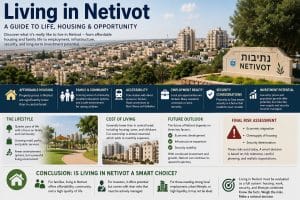 Living in Netivot offers a distinct experience within Israel’s evolving residential landscape. Located in the country’s south, Netivot has transformed from a modest development town into a rapidly growing city attracting families, investors, and buyers seeking affordability without fully disconnecting from central Israel. The appeal of living in Netivot lies in its combination of lower property prices, expanding infrastructure, and a strong sense of community.
Over the past decade, living in Netivot has shifted from being a niche option to a strategic choice for those priced out of cities like Tel Aviv, Ashdod, or even Be’er Sheva. However, this growth has not been without trade-offs. To properly evaluate living in Netivot, one must analyse housing supply, demographics, employment opportunities, infrastructure, and long-term sustainability.
Location and Accessibility
One of the most misunderstood aspects of living in Netivot is its location. While geographically positioned in southern Israel, Netivot is not as isolated as many assume. The city sits near key transport routes, including Route 25 and Route 34, connecting it to Be’er Sheva and Ashkelon.
Rail connectivity has improved significantly. The Netivot train station allows commuters to reach Tel Aviv in approximately 1 hour and 15 minutes under optimal conditions. That is not ideal for daily commuting, but it is viable for hybrid work models. For buyers considering living in Netivot, this is a critical point: the city works best for those who do not rely on daily central Israel commuting.
However, transport infrastructure still lags behind demand. Peak-hour congestion and limited train frequency reduce efficiency. Any long-term decision about living in Netivot must factor in reliance on private vehicles.
Housing Market and Property Prices
The primary driver behind living in Netivot is cost. Property prices remain significantly lower than in central Israel and even compared to nearby cities.
Apartments in Netivot typically range between ₪1.2M and ₪1.8M for standard 3–4 room units, depending on neighbourhood and new-build status. Larger family homes or upgraded properties can exceed ₪2M, but still remain below national averages.
New construction projects have been central to the expansion of living in Netivot. Entire neighbourhoods have been developed with modern infrastructure, elevators, parking, and improved urban planning. This is a major advantage compared to older development towns where outdated housing stock dominates.
However, supply growth introduces risk. If construction continues at current rates without parallel job creation, price stagnation or even correction becomes likely. Anyone entering the market based purely on affordability should recognise that living in Netivot is not guaranteed to deliver strong capital appreciation.
Neighbourhood Development
Living in Netivot is heavily shaped by its neighbourhood structure. Newer areas offer significantly different living conditions compared to older sections of the city.
Modern neighbourhoods feature:
- Planned streets and green spaces
- Schools and community centres integrated into design
- Higher-quality buildings
- Family-oriented environments
Older areas, by contrast, reflect the city’s origins as a development town. Infrastructure can be weaker, buildings older, and public spaces less maintained.
This creates a two-tier reality for living in Netivot. Buyers must be precise in choosing location within the city. A poor neighbourhood choice can undermine the advantages typically associated with living in Netivot.
Community and Demographics
Living in Netivot is strongly defined by its community. The city has a predominantly traditional and religious population, with a growing number of young families moving in from other parts of Israel.
The influence of Rabbi Yisrael Abuhatzeira (the Baba Sali) has shaped the city’s identity, making it a centre for religious life and pilgrimage. This contributes to a strong communal atmosphere, particularly during religious events and holidays.
For families seeking a close-knit environment, living in Netivot offers clear advantages. Social cohesion is high, and community support systems are well established.
However, this same characteristic may be a limitation for those seeking a more secular or cosmopolitan lifestyle. Cultural fit is a real factor when evaluating living in Netivot, and ignoring it leads to poor long-term satisfaction.
Education and Family Life
A major reason people choose living in Netivot is its suitability for raising children. The city has invested heavily in education infrastructure, including:
- Kindergartens and primary schools
- Religious and secular school options
- Youth programmes and extracurricular activities
Class sizes tend to be manageable, and the environment is generally considered safe and family-oriented.
Compared to central Israel, living in Netivot offers a slower pace of life, which many families find beneficial. Children grow up in less crowded environments, with greater access to outdoor spaces.
That said, educational quality can vary between institutions. Families considering living in Netivot should conduct specific school-level research rather than relying on general assumptions.
Employment and Economic Reality
This is where the strongest challenge to living in Netivot emerges. Local employment opportunities remain limited relative to population growth.
The city does not yet have a strong independent economic base. Many residents either commute to Be’er Sheva or rely on remote work. Industrial zones exist but are not sufficiently developed to support large-scale employment.
This creates a structural imbalance. Housing supply has increased faster than job creation. If not corrected, this weakens long-term economic stability.
For anyone considering living in Netivot, income source must be addressed first. Without a clear employment strategy, the affordability advantage becomes irrelevant.
Cost of Living in Netivot
Living in Netivot generally comes with a lower cost of living compared to central Israel. Key advantages include:
- Lower housing costs
- Reduced municipal taxes (arnona in many cases)
- Cheaper childcare options
- Lower overall service costs
However, some expenses offset these savings. Car ownership is almost essential, increasing transport costs. Limited local competition in certain services can also lead to higher prices in specific sectors.
The net effect is still favourable. Living in Netivot is typically cheaper than living in cities like Tel Aviv, Rishon LeZion, or Herzliya, but not as cheap as many assume once all factors are included.
Infrastructure and Urban Development
The municipality has invested in improving infrastructure, but progress is uneven. Roads, parks, and public buildings have seen upgrades, particularly in newer neighbourhoods.
Retail development has also expanded, with shopping centres and local businesses growing alongside population increases. However, Netivot still lacks the diversity and scale of services found in larger cities.
Healthcare access is adequate but not exceptional. Residents often rely on nearby cities for specialised medical services.
Living in Netivot today means accepting a city in transition. It is neither underdeveloped nor fully mature. This transitional phase creates both opportunity and risk.
Lifestyle and Daily Experience
The lifestyle associated with living in Netivot is quieter and more structured compared to central Israel. Daily life revolves around family, work, and community rather than nightlife or urban culture.
There are fewer entertainment options, limited cultural institutions, and less variety in restaurants and leisure activities. For some, this is a drawback. For others, it is precisely the appeal.
The key question is alignment. Living in Netivot suits individuals prioritising stability, affordability, and community over diversity and urban intensity.
Safety and Security Considerations
Any serious discussion of living in Netivot must address security. The city’s proximity to the Gaza Strip introduces a factor that cannot be ignored.
Rocket alerts and security incidents have historically affected the area. While infrastructure such as shelters and Iron Dome coverage has improved resilience, the psychological and practical implications remain.
This is not a theoretical issue. It directly impacts daily life, property values, and long-term desirability.
Anyone evaluating living in Netivot must weigh affordability against this risk. Ignoring it leads to flawed decision-making.
Investment Potential
From an investment perspective, living in Netivot presents a mixed picture.
Positive factors include:
- Low entry prices
- Population growth
- Ongoing development
Negative factors include:
- Limited local economy
- Security concerns
- Oversupply risk
Rental demand exists, particularly from young families and lower-income groups, but yields are not exceptionally high compared to risk.
Investors should avoid assuming that living in Netivot automatically translates into strong returns. The market requires careful analysis and realistic expectations.
Future Outlook
The future of living in Netivot depends on three variables:
- Economic development
- Infrastructure expansion
- Security stability
If employment opportunities increase and infrastructure keeps pace with population growth, the city could continue its upward trajectory.
If not, growth may stall. Housing oversupply combined with limited demand would put downward pressure on prices.
Government policy will play a major role. Investment in southern Israel has historically fluctuated, and Netivot’s future is tied to broader regional planning.
Practical Considerations Before Moving
Before committing to living in Netivot, several practical factors need to be stress-tested rather than assumed. One of the most common mistakes is focusing almost entirely on purchase price while underestimating friction in daily life. For example, grocery access, school placement, commute variability, and healthcare availability all have second-order effects that accumulate over time. Living in Netivot may look financially attractive on paper, but inefficiencies in day-to-day logistics can erode that advantage.
Transport is a clear example. While the train connection exists, reliability and scheduling matter more than theoretical travel time. If a commuter misses a train, the delay can be significant. Bus networks exist but are not always optimised for speed or frequency. As a result, households often default to owning one or two cars, which introduces depreciation, fuel, insurance, and maintenance costs. When these are fully accounted for, the savings from living in Netivot shrink, though they usually remain positive compared to central Israel.
Another overlooked issue is resale liquidity. Property in Netivot does not move at the same speed as in high-demand urban centres. If market conditions weaken, selling can take longer, particularly in neighbourhoods with high supply of similar units. This is not a theoretical risk—it has already been observed in periods where new construction temporarily outpaced buyer demand. Anyone planning on living in Netivot for a short or medium-term horizon should factor in exit risk, not just entry price.
Strategic Positioning Within the Israeli Property Market
To understand living in Netivot properly, it must be placed within the broader Israeli housing system. The city functions as a pressure-release valve for demand coming from more expensive areas. As prices rise in the centre, buyers move outward, and Netivot captures part of that migration flow. This dynamic supports baseline demand, but it is not infinite. If alternative cities offer better employment access or infrastructure at similar price points, demand can shift away.
Compared to Be’er Sheva, Netivot lacks a university-driven economy and large employment hubs. Compared to Ashkelon, it has less coastal appeal and weaker transport links to the centre. These relative disadvantages matter when buyers compare options. Living in Netivot works best when price gaps remain wide. If those gaps narrow, the city becomes less competitive.
At the same time, there is a structural argument in favour of long-term relevance. Israel’s population continues to grow, and housing demand remains persistent. Even secondary cities benefit from this macro trend. Living in Netivot is therefore partly a bet on continued national housing pressure. That is a reasonable assumption, but it is not a guarantee of outperformance.
Final Risk Assessment and Conclusion: Is Living in Netivot a Smart Choice?
A clear-eyed assessment of living in Netivot requires identifying the main failure scenarios and then judging whether the benefits still outweigh them. The first risk is economic stagnation. If job creation does not keep pace with population growth, the city becomes too dependent on residents earning income elsewhere, whether through commuting or remote work. That weakens local resilience and reduces the long-term strength of the housing market. The second risk is oversupply. Continued construction without enough real end-user demand can suppress prices, slow resale activity, and make the market less attractive for both buyers and investors. The third risk is security deterioration, which would have an immediate effect on confidence, property demand, and pricing.
None of these risks are theoretical. They already exist to varying degrees, which means that any decision about living in Netivot should be based on risk tolerance rather than wishful thinking. Buyers who understand these constraints, price them in properly, and choose neighbourhoods and budgets carefully may still find real value. Buyers who focus only on affordability are more likely to misread the opportunity.
That is why living in Netivot is not a universally good or bad decision. It is highly context-dependent. For families seeking lower housing costs, a strong sense of community, and a quieter daily environment, the city can be a solid option. For investors, it may offer potential, but only if they are realistic about the limits of the local economy and the downside risks tied to supply and security. On the other hand, for people who need strong local employment, a more urban lifestyle, or faster property liquidity, living in Netivot may be the wrong fit.
The central mistake is to judge the city through a single lens. Affordability alone does not equal value. Living in Netivot needs to be judged as a full system in which housing, employment, security, transport, and lifestyle all interact. A rational decision requires removing sentiment and testing the fundamentals. Only then does the real picture of living in Netivot become clear.
Israel Homes Is a Guide to Finding, Understanding, and Buying Property in Israel