
Guide to Annual Israel Real Estate Market Forecast
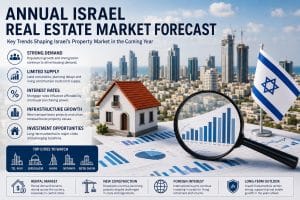 The Annual Israel Real Estate Market Forecast is one of the most valuable resources for buyers, sellers, investors, developers, and property professionals seeking to understand where the Israeli property market is heading. Israel’s housing market is influenced by a unique combination of population growth, immigration, limited land availability, government policy, interest rates, geopolitical events, and economic performance.
Every year, thousands of local buyers and international investors review an Annual Israel Real Estate Market Forecast before making major financial decisions. While no forecast can predict the future with complete certainty, analysing market fundamentals provides valuable insight into likely trends for prices, rental demand, construction activity, and investment opportunities.
Whether you are considering purchasing a home in Jerusalem, investing in Tel Aviv, buying an apartment in Netanya, relocating to Beit Shemesh, or investing in Haifa, understanding the latest Annual Israel Real Estate Market Forecast helps reduce risk and improve decision-making.
This comprehensive guide explores the factors expected to shape Israel’s property market during the coming year.
Why an Annual Israel Real Estate Market Forecast Matters
An Annual Israel Real Estate Market Forecast helps market participants prepare for changing conditions rather than reacting after prices have already moved.
Property transactions involve significant financial commitments, making forward-looking analysis particularly valuable.
A yearly forecast helps:
- Buyers determine whether to purchase now or wait.
- Investors identify high-growth locations.
- Sellers price their homes realistically.
- Developers assess demand before launching projects.
- Mortgage borrowers understand financing risks.
- Overseas buyers plan their investments.
Unlike many countries where housing cycles can be dramatic, Israel’s housing market often moves differently because structural demand remains consistently high.
Several long-term factors continue supporting demand.
Population Growth
Israel has one of the fastest-growing populations in the developed world.
Natural population growth continually increases housing demand across:
- Jerusalem
- Tel Aviv
- Haifa
- Ashdod
- Netanya
- Modiin
- Ramat Gan
- Herzliya
- Be’er Sheva
- Beit Shemesh
This demographic trend remains one of the strongest foundations within every Annual Israel Real Estate Market Forecast.
Immigration
Aliyah continues creating additional housing demand.
New immigrants often purchase homes shortly after arriving, particularly in English-speaking communities including:
- Jerusalem
- Netanya
- Ra’anana
- Beit Shemesh
- Herzliya
- Modiin
International buyers also remain active in luxury and investment sectors.
Limited Land
Israel’s geography naturally limits available land.
Large portions are reserved for:
- Agriculture
- Military use
- Nature reserves
- Infrastructure
This restricts housing supply even when demand continues growing.
Interest Rates and Mortgage Trends
Interest rates remain one of the biggest variables affecting the Annual Israel Real Estate Market Forecast.
Higher mortgage rates reduce affordability.
Lower rates increase purchasing power.
During periods of elevated interest rates, buyers typically:
- Delay purchases
- Buy smaller homes
- Negotiate harder
- Compare mortgage offers more carefully
Developers may also offer:
- Flexible payment plans
- Price incentives
- Mortgage assistance
- Reduced deposits
If interest rates decline during the coming year, demand could strengthen considerably.
Housing Supply Outlook
One of the biggest themes in every Annual Israel Real Estate Market Forecast is housing supply.
Israel still faces a long-term shortage of residential units.
Although construction activity has increased in recent years, demand continues exceeding supply in many regions.
Factors affecting supply include:
- Labour shortages
- Planning delays
- Infrastructure development
- Municipality approvals
- Rising construction costs
These challenges prevent rapid increases in housing availability.
Regional Market Forecast
Israel’s property market is highly regional.
Different cities experience different trends.
Jerusalem
Jerusalem remains one of Israel’s strongest long-term housing markets.
Demand comes from:
- Local families
- Religious communities
- Overseas buyers
- Investors
- New immigrants
Prime neighbourhoods are expected to remain resilient.
Luxury properties may experience slower transaction volumes while maintaining relatively stable prices.
Tel Aviv
Tel Aviv continues attracting:
- Technology professionals
- Investors
- Young professionals
- International buyers
Limited land keeps supply constrained.
Although prices may fluctuate during periods of higher interest rates, long-term demand remains exceptionally strong.
Rental demand is expected to remain among Israel’s highest.
Netanya
Netanya continues attracting English-speaking immigrants.
Its beachfront location, modern neighbourhoods and strong infrastructure support long-term growth.
The Annual Israel Real Estate Market Forecast suggests continuing demand for family apartments and retirement properties.
Haifa
Haifa offers relatively affordable property compared with central Israel.
Strong universities, technology employment and urban renewal projects support future growth.
Investors seeking rental income continue showing interest.
Be’er Sheva
Be’er Sheva continues expanding through:
- University growth
- Defence industry relocation
- Infrastructure investment
Demand remains strongest near employment centres and educational institutions.
Beit Shemesh
Beit Shemesh remains one of Israel’s fastest-growing cities.
Population growth continues supporting housing demand despite increasing supply.
Many English-speaking buyers continue relocating here.
Modiin
Modiin offers:
- Excellent transportation
- High-quality schools
- Strong family demand
- Convenient access to Jerusalem and Tel Aviv
Supply remains relatively limited compared with demand.
Rental Market Forecast
Rental demand remains strong nationwide.
Several factors support the rental market:
- High purchase prices
- Population growth
- Immigration
- Students
- Young professionals
Cities expected to maintain particularly strong rental demand include:
- Tel Aviv
- Jerusalem
- Haifa
- Netanya
- Be’er Sheva
- Herzliya
Rental yields vary significantly by city.
While central Israel generally offers lower yields, appreciation potential often remains higher.
Peripheral cities may produce stronger rental returns.
New Construction Outlook
Developers continue launching projects throughout Israel.
However, several challenges remain.
Construction costs have increased because of:
- Labour shortages
- Material prices
- Financing costs
- Regulatory requirements
Urban renewal projects continue representing a significant source of future housing.
Tama 38 replacements and larger redevelopment programmes remain active across:
- Tel Aviv
- Ramat Gan
- Givatayim
- Bat Yam
- Jerusalem
- Haifa
These projects are expected to contribute substantially to future housing supply.
Foreign Buyer Activity
International interest remains an important element of the Annual Israel Real Estate Market Forecast.
Foreign buyers continue purchasing property for:
- Investment
- Holiday homes
- Retirement
- Aliyah planning
- Family use
Buyers from:
- United Kingdom
- United States
- France
- Canada
- Australia
- South Africa
continue supporting demand in premium markets.
Jerusalem and Netanya remain particularly attractive to overseas purchasers.
Infrastructure Projects Affecting Prices
Major infrastructure improvements often influence local property values.
Projects expected to affect future prices include:
- Light rail expansion
- Railway improvements
- New highways
- Employment centres
- Urban renewal
Improved transport links often increase demand in previously less accessible neighbourhoods.
Investors frequently monitor these developments when reviewing an Annual Israel Real Estate Market Forecast.
Risks That Could Affect the Forecast
Every forecast contains uncertainty.
Potential risks include:
Interest Rate Changes
Unexpected increases could reduce buyer affordability.
Inflation
Higher inflation increases construction costs.
Geopolitical Events
Regional instability can temporarily reduce transaction activity.
However, Israel’s housing market has historically demonstrated resilience following periods of uncertainty.
Government Policy
Changes affecting:
- Purchase tax
- Capital gains tax
- Planning regulations
- Housing incentives
could influence market behaviour.
Global Economy
International economic conditions may affect overseas investment into Israeli property.
Investment Opportunities
Although every investor has different goals, several opportunities appear attractive.
Long-Term Appreciation
Cities with limited supply and growing populations remain attractive.
These include:
- Jerusalem
- Tel Aviv
- Herzliya
- Ra’anana
- Modiin
Rental Income
Higher rental yields may be available in:
- Be’er Sheva
- Haifa
- Ashkelon
- Ashdod
Urban Renewal
Apartments located within approved redevelopment areas may experience above-average appreciation over time.
New Developments
Buying during early construction phases can sometimes provide pricing advantages.
However, buyers should carefully evaluate developer reputation and financial stability.
Advice for Buyers
The Annual Israel Real Estate Market Forecast suggests buyers should focus on long-term affordability rather than attempting to perfectly time the market.
Important considerations include:
- Mortgage affordability
- Future employment
- School locations
- Transport links
- Building quality
- Resale potential
Purchasing a property suited to long-term needs often proves more important than short-term price movements.
Advice for Sellers
Sellers should understand local market conditions rather than relying solely on national headlines.
Professional pricing remains essential.
Overpriced properties often remain on the market significantly longer.
Preparing a property properly through cleaning, repairs and professional photography can improve buyer interest.
Advice for Investors
Successful investors typically focus on:
- Cash flow
- Rental demand
- Infrastructure
- Population growth
- Long-term appreciation
- Property management
Speculation based solely on short-term market movements carries greater risk.
Diversification across different cities or property types may reduce exposure.
Long-Term Outlook
Although short-term fluctuations are inevitable, the long-term fundamentals supporting Israeli real estate remain strong.
Key structural drivers include:
- Rapid population growth
- Continued immigration
- Strong employment sectors
- Limited land availability
- Ongoing infrastructure investment
- High homeownership demand
These factors have historically supported property values over extended periods.
While annual price growth may vary considerably, many analysts expect demand to remain robust over the coming decade.
How Technology Is Influencing the Annual Israel Real Estate Market Forecast
Technology is playing an increasingly important role in every Annual Israel Real Estate Market Forecast. Buyers, sellers, investors and estate agents now rely on digital tools more than ever before when researching property opportunities across Israel. Online property portals, virtual tours, artificial intelligence, geographic information systems and digital mortgage applications are changing how real estate transactions are conducted.
For buyers living overseas, technology has made purchasing property in Israel significantly easier. Many new immigrants and foreign investors begin their search months before arriving in the country. They compare neighbourhoods, estimate mortgage payments, analyse rental yields and communicate with lawyers and estate agents entirely online. This increased transparency allows buyers to make more informed decisions before committing to a purchase.
Artificial intelligence is also beginning to influence property valuation. Automated valuation models can compare thousands of recent sales, identify pricing trends and estimate fair market values based on historical transaction data. While these systems cannot replace professional appraisals, they provide another useful tool for buyers and investors studying the market.
Digital marketing has also become one of the biggest factors affecting the Israeli property industry. Developers increasingly promote new projects through social media, video marketing, search engines and virtual reality presentations rather than relying solely on traditional advertising. This allows projects in cities such as Jerusalem, Netanya, Haifa, Ashdod and Be’er Sheva to reach international audiences much more effectively.
The growth of remote work has further influenced housing demand. Buyers who no longer need to commute daily may consider larger homes in suburban or peripheral areas where prices are lower and quality of life is higher. This shift could gradually reshape demand patterns highlighted in future editions of the Annual Israel Real Estate Market Forecast.
Data availability has also improved dramatically. Government transaction databases, municipal planning information and market statistics provide investors with better insight into neighbourhood trends than was possible only a decade ago. As data quality improves, forecasts become more accurate and investors can make decisions based on evidence rather than speculation.
Although technology cannot eliminate market uncertainty, it enables buyers and investors to identify risks earlier, compare opportunities more efficiently and monitor changing market conditions in real time.
Government Policies That Could Shape the Annual Israel Real Estate Market Forecast
Government policy remains one of the most significant variables within every Annual Israel Real Estate Market Forecast. Israel’s housing market is heavily influenced by planning regulations, taxation, infrastructure spending and programmes designed to increase housing supply.
One important area is land development. Much of Israel’s land is publicly owned, meaning the pace of residential construction often depends on government planning decisions. Accelerating zoning approvals and releasing additional land for housing could increase supply and reduce pressure on prices over the long term.
Urban renewal policies also continue to influence many cities. Redevelopment programmes replacing ageing apartment buildings with modern high-density developments remain active throughout central Israel. These projects not only increase housing supply but also improve infrastructure, earthquake resistance and neighbourhood quality.
Tax policy is another factor closely monitored by investors. Purchase tax rates for second homes, capital gains taxation and incentives for first-time buyers can all affect market activity. Even relatively small changes in taxation sometimes lead buyers to accelerate or postpone purchasing decisions.
Mortgage regulations introduced by financial authorities also influence affordability. Requirements relating to loan-to-value ratios, debt-to-income limits and fixed versus variable interest rate exposure help maintain financial stability while affecting borrowing capacity. These policies often receive significant attention within an Annual Israel Real Estate Market Forecast because they directly influence buyer demand.
Government investment in transportation infrastructure also shapes future property values. New railway stations, light rail extensions and major highway improvements often increase demand in surrounding neighbourhoods. Areas previously considered peripheral may become much more attractive once commuting times improve.
Support for new immigrants can also influence housing demand. Assistance programmes, financing options and housing grants may encourage additional property purchases among Olim, particularly in cities with established English-speaking and French-speaking communities.
While government policies can change over time, long-term planning initiatives generally aim to balance housing affordability with continued economic growth. Investors should therefore monitor both national legislation and municipal planning decisions when evaluating future opportunities.
Strategies for Navigating the Annual Israel Real Estate Market Forecast
Understanding an Annual Israel Real Estate Market Forecast is only the first step. Buyers and investors must also develop strategies that allow them to respond effectively to changing market conditions rather than simply reacting to headlines.
The first strategy is adopting a long-term perspective. Israeli real estate has historically experienced periods of slower growth, temporary corrections and strong appreciation. Attempting to predict short-term price movements is considerably more difficult than investing based on long-term demographic and economic fundamentals.
Location should remain the primary consideration. Properties situated near employment centres, quality schools, public transportation and future infrastructure projects generally maintain stronger long-term demand. Even during slower market periods, well-located homes often outperform less desirable locations.
Financial preparation is equally important. Buyers should maintain sufficient emergency savings in addition to their deposit. Mortgage repayments should remain affordable even if interest rates increase or household income temporarily declines. Conservative financial planning reduces the likelihood of distress during economic uncertainty.
Investors should also analyse expected rental demand rather than relying exclusively on projected price appreciation. Cities with universities, hospitals, technology companies and growing employment sectors frequently provide more stable rental markets throughout changing economic cycles.
Diversification may reduce overall investment risk. Rather than concentrating entirely in one neighbourhood or one property type, some investors choose to spread investments across different cities or residential sectors. This approach can help offset localised market fluctuations.
Professional advice also remains valuable. Working with experienced estate agents, mortgage advisers, surveyors, lawyers and tax professionals helps buyers understand the legal and financial aspects of purchasing property in Israel. Independent advice becomes especially important for overseas investors unfamiliar with local regulations.
Finally, every Annual Israel Real Estate Market Forecast should be viewed as a planning tool rather than a guarantee. Forecasts identify likely trends based on current information, but unexpected economic, political or global developments can influence the market. Buyers who remain flexible, conduct thorough research and focus on long-term objectives are generally better equipped to achieve successful property outcomes regardless of short-term market movements.
Conclusion Annual Israel Real Estate Market Forecast
The Annual Israel Real Estate Market Forecast indicates that Israel’s housing market continues to benefit from powerful long-term fundamentals despite short-term economic uncertainty. Population growth, immigration, constrained housing supply and ongoing infrastructure investment remain important drivers supporting residential property demand across the country. Although interest rates, inflation, construction costs and geopolitical developments may influence market activity during the coming year, buyers and investors who adopt a long-term perspective are generally better positioned to navigate market fluctuations. Whether purchasing a family home in Jerusalem, investing in rental property in Haifa, considering beachfront apartments in Netanya or exploring opportunities in Be’er Shemesh, understanding the Annual Israel Real Estate Market Forecast provides valuable insight for making informed real estate decisions. Careful research, realistic budgeting and attention to local market conditions remain the keys to achieving success in Israel’s dynamic property market.