
Fixed vs Variable Mortgages in Israel: Which Mortgage Option Is Right for You?
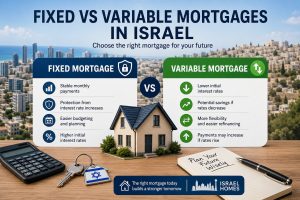 When purchasing property in Israel, one of the most important financial decisions buyers face is choosing between Fixed vs Variable Mortgages in Israel. Whether you are an Israeli resident, a new immigrant making aliyah, an overseas investor, or a foreign buyer purchasing a holiday home, understanding Fixed vs Variable Mortgages in Israel can have a significant impact on your monthly payments, long-term financial stability, and overall property investment returns.
The Israeli mortgage market is unique compared to many other countries. Mortgage borrowers can combine several loan tracks into a single mortgage package, allowing them to balance risk and flexibility. Because of this flexibility, understanding Fixed vs Variable Mortgages in Israel is essential before signing any mortgage agreement.
Many buyers focus primarily on property prices in Jerusalem, Tel Aviv, Netanya, Herzliya, Ra’anana, Beit Shemesh, Modiin, or Haifa. However, the mortgage structure chosen can sometimes affect the total cost of ownership more than the purchase price itself. A difference of just a small percentage point in interest rates can translate into hundreds of thousands of shekels over the life of a mortgage.
This guide explains Fixed vs Variable Mortgages in Israel, how each option works, their advantages and disadvantages, current market considerations, and how buyers can determine which solution best fits their financial goals.
Understanding the Israeli Mortgage Market
Before comparing Fixed vs Variable Mortgages in Israel, it is important to understand how mortgages are structured in Israel.
Unlike many countries where borrowers choose a single mortgage product, Israeli mortgages are often divided into several tracks.
A mortgage may include:
- Fixed-rate portions
- Variable-rate portions
- Prime-linked portions
- CPI-linked portions
- Non-indexed portions
- Foreign currency-linked portions
Israeli banks frequently recommend splitting mortgage exposure across multiple tracks to reduce risk.
Major lenders include:
- Bank Hapoalim
- Bank Leumi
- Mizrahi-Tefahot Bank
- Discount Bank
- First International Bank of Israel
When evaluating Fixed vs Variable Mortgages in Israel, borrowers should remember that they are often not choosing one or the other exclusively. Instead, they may combine both approaches.
What Is a Fixed Mortgage in Israel?
A fixed mortgage means the interest rate remains unchanged throughout the agreed mortgage period.
With fixed-rate financing, borrowers know exactly what interest rate they will pay regardless of future economic conditions.
For example:
- Mortgage amount: 1,500,000 NIS
- Term: 25 years
- Fixed interest rate: 4.8%
The interest rate remains constant for the entire term.
This stability makes fixed-rate mortgages popular among:
- Families
- New immigrants
- First-time buyers
- Retirees
- Risk-averse investors
The primary attraction of Fixed vs Variable Mortgages in Israel is certainty.
Borrowers know:
- Future monthly payments
- Long-term costs
- Household budgeting requirements
This predictability can provide peace of mind during periods of economic uncertainty.
Advantages of Fixed Mortgages
Payment Stability
The biggest benefit of fixed mortgages is predictability.
Monthly repayments remain stable regardless of:
- Inflation changes
- Interest rate hikes
- Economic downturns
- Geopolitical uncertainty
For families purchasing homes in Jerusalem, Beit Shemesh, Efrat, Ra’anana, or Modiin, stable payments often make financial planning easier.
Protection Against Rising Interest Rates
If the Bank of Israel increases interest rates significantly, fixed-rate borrowers are protected.
This can become extremely valuable during periods of high inflation or economic instability.
Easier Budget Management
When comparing Fixed vs Variable Mortgages in Israel, fixed mortgages are often easier to manage because future costs are known from day one.
This can help:
- New olim
- Young families
- Retirees
- Buyers relying on fixed income
Disadvantages of Fixed Mortgages
Higher Initial Rates
Banks typically charge higher interest rates for fixed-rate certainty.
As a result:
- Initial monthly payments may be higher.
- Total borrowing costs can initially appear more expensive.
Early Repayment Penalties
Many fixed mortgages include early repayment fees.
If interest rates fall and borrowers wish to refinance, they may face substantial penalties.
Reduced Flexibility
Fixed mortgages provide certainty but less flexibility.
Borrowers who expect significant income growth may find themselves locked into a structure that is not optimal in future years.
What Is a Variable Mortgage in Israel?
A variable mortgage has an interest rate that changes periodically according to a predefined formula.
The most common examples include:
- Prime-linked mortgages
- Variable-rate mortgages adjusted every 1, 2, 5, or 10 years
- CPI-linked variable mortgages
In a variable mortgage, payments may rise or fall depending on economic conditions.
This creates both opportunity and risk.
When discussing Fixed vs Variable Mortgages in Israel, variable mortgages are generally chosen by borrowers seeking lower initial payments and greater flexibility.
Advantages of Variable Mortgages
Lower Initial Interest Rates
Variable mortgages often begin with lower interest rates than fixed mortgages.
This means:
- Lower monthly payments
- Improved short-term affordability
- Better cash flow
For property investors purchasing apartments in Tel Aviv, Netanya, Herzliya, Ashdod, or Haifa, lower initial costs can improve investment returns.
Greater Refinancing Flexibility
Variable mortgages typically involve fewer penalties when refinancing.
This allows borrowers to:
- Restructure debt
- Reduce loan terms
- Switch mortgage products
more easily.
Potential Savings if Rates Fall
If interest rates decline, variable-rate borrowers automatically benefit.
Their monthly payments may decrease without requiring refinancing.
This is one reason some investors favour variable-rate borrowing when analysing Fixed vs Variable Mortgages in Israel.
Disadvantages of Variable Mortgages
Payment Uncertainty
The biggest disadvantage is unpredictability.
Monthly payments can rise significantly.
This creates financial pressure for households with limited flexibility.
Exposure to Interest Rate Increases
When interest rates rise:
- Mortgage costs rise
- Monthly repayments increase
- Total borrowing costs increase
Many Israeli borrowers experienced this after the rapid interest-rate increases that began in 2022.
Long-Term Budgeting Challenges
Variable rates make future planning more difficult.
Borrowers cannot accurately predict future mortgage costs.
This uncertainty is one of the key considerations when evaluating Fixed vs Variable Mortgages in Israel.
Fixed vs Variable Mortgages in Israel: Direct Comparison
Monthly Payment Stability
Fixed mortgages win.
Payments remain predictable.
Variable mortgages may fluctuate significantly.
Initial Affordability
Variable mortgages often win.
Starting payments are usually lower.
Protection Against Interest Rate Hikes
Fixed mortgages provide better protection.
Variable mortgages expose borrowers to rising costs.
Flexibility
Variable mortgages generally offer greater flexibility.
Refinancing is often easier and less expensive.
Long-Term Predictability
Fixed mortgages provide superior certainty.
This is particularly important for families purchasing a primary residence.
How Inflation Affects Fixed vs Variable Mortgages in Israel
Inflation is a major consideration in Israel.
Many mortgage products are linked to the Consumer Price Index (CPI).
Even some fixed-rate mortgages may remain CPI-linked.
This means:
- Interest remains fixed.
- Principal balance may increase with inflation.
When analysing Fixed vs Variable Mortgages in Israel, borrowers must understand that fixed interest does not necessarily mean fixed loan balance if CPI linkage applies.
For this reason, many borrowers prefer non-indexed fixed-rate mortgages despite their higher initial interest rates.
Fixed vs Variable Mortgages in Israel for New Immigrants
New immigrants often face unique challenges.
Income may be uncertain during the first years after aliyah.
Employment transitions can create financial pressure.
For many olim purchasing homes in:
- Jerusalem
- Beit Shemesh
- Ra’anana
- Modiin
- Efrat
payment certainty becomes particularly valuable.
This often makes fixed-rate mortgage components attractive.
However, younger immigrants expecting rising income may benefit from combining fixed and variable tracks to reduce initial costs.
Fixed vs Variable Mortgages in Israel for Investors
Investors often approach mortgages differently.
Their focus is typically:
- Cash flow
- Rental yield
- Return on investment
- Flexibility
Variable-rate mortgages may provide advantages when:
- Interest rates are expected to fall.
- Property appreciation is anticipated.
- Properties may be sold within a few years.
However, investors must carefully stress-test cash flow under higher-rate scenarios.
How Israeli Banks Assess Fixed vs Variable Mortgages in Israel
When borrowers apply for financing, Israeli banks do not simply evaluate income and property value. They also analyse the borrower’s ability to withstand future interest-rate increases.
This has become particularly important following recent periods of rising interest rates. Israeli regulators have encouraged banks to ensure borrowers are not excessively exposed to variable-rate debt.
When considering Fixed vs Variable Mortgages in Israel, banks typically examine:
- Monthly income
- Existing debt obligations
- Employment stability
- Property type
- Loan-to-value ratio
- Age of borrower
- Expected future income
A borrower purchasing a home in Jerusalem with a stable government salary may receive different mortgage recommendations than a self-employed entrepreneur purchasing an investment property in Tel Aviv.
Many banks encourage diversification by splitting mortgage exposure between fixed and variable tracks. This strategy reduces concentration risk and can help borrowers maintain affordability if market conditions change.
The Role of the Bank of Israel Interest Rate
One of the most important factors affecting Fixed vs Variable Mortgages in Israel is the Bank of Israel interest rate.
The Bank of Israel uses interest rates as a tool to manage inflation and economic growth.
When inflation rises:
- Interest rates often increase.
- Mortgage costs rise.
- Variable-rate borrowers pay more.
When inflation falls:
- Interest rates may decrease.
- Variable mortgage payments can fall.
- Borrowers may save money.
Fixed-rate borrowers are largely protected from these fluctuations.
This relationship means that anyone evaluating Fixed vs Variable Mortgages in Israel should pay attention to economic forecasts, inflation expectations, and central bank policy.
Fixed vs Variable Mortgages in Israel During High Inflation
Israel has experienced periods of significant inflation throughout its history.
During inflationary periods:
- Central bank rates often rise.
- Variable mortgage payments increase.
- CPI-linked mortgage balances can grow.
Fixed-rate mortgages generally become more attractive because they provide certainty.
However, even fixed-rate borrowers should carefully review whether their mortgage is indexed to the Consumer Price Index.
Many buyers mistakenly assume that a fixed mortgage guarantees a fixed balance. In reality, CPI-linked fixed mortgages may still increase in principal value as inflation rises.
This distinction is crucial when analysing Fixed vs Variable Mortgages in Israel.
Fixed vs Variable Mortgages in Israel During Falling Interest Rates
The opposite scenario can also occur.
When inflation decreases and economic growth slows, central banks may lower interest rates.
In such environments:
- Variable mortgage payments decline.
- Refinancing opportunities increase.
- Borrowers can reduce financing costs.
Variable-rate borrowers may benefit substantially from these conditions.
This explains why some investors deliberately choose variable mortgage exposure when they believe interest rates are likely to decline over the coming years.
However, predicting interest-rate movements consistently is extremely difficult, even for professional economists.
Therefore, borrowers should avoid basing their entire mortgage strategy on forecasts alone.
Mortgage Strategies for First-Time Home Buyers
First-time buyers often struggle with the decision between Fixed vs Variable Mortgages in Israel.
Many first-time buyers are purchasing:
- Their first apartment in Jerusalem
- A starter home in Beit Shemesh
- A family property in Modiin
- An apartment in Netanya
- A home in Ra’anana
Because mortgage payments represent a large portion of household income, predictability often becomes a priority.
For many first-time buyers:
- Fixed-rate components provide security.
- Variable-rate components reduce initial payments.
A balanced combination frequently provides the best compromise between affordability and risk management.
Mortgage Strategies for Property Investors
Investors often evaluate Fixed vs Variable Mortgages in Israel differently than homeowners.
Their priorities include:
- Rental income
- Capital appreciation
- Cash flow optimisation
- Tax efficiency
- Portfolio growth
Because investors often sell properties before the mortgage term expires, flexibility may be more important than payment certainty.
Variable mortgages can therefore become attractive because they frequently carry:
- Lower starting rates
- Lower refinancing costs
- Lower early repayment penalties
However, investors should never assume that rising rents will fully offset rising mortgage payments.
Successful real estate investors stress-test their finances against worst-case scenarios.
Mortgage Strategies for Foreign Buyers
Foreign buyers represent a significant segment of Israel’s real estate market.
Many purchase property in:
- Jerusalem
- Netanya
- Herzliya
- Tel Aviv
- Ashdod
When comparing Fixed vs Variable Mortgages in Israel, foreign buyers face additional considerations.
These include:
- Currency fluctuations
- International income sources
- Different tax jurisdictions
- Exchange-rate risk
For buyers earning dollars, pounds, euros, or other currencies, mortgage stability can provide valuable protection against unpredictable exchange-rate movements.
This is one reason many foreign purchasers prefer larger fixed-rate allocations.
Mortgage Strategies for New Olim
Thousands of new immigrants arrive in Israel each year.
For many olim, purchasing property becomes a major milestone.
However, the first years following aliyah often involve:
- Career transitions
- Salary adjustments
- Hebrew language acquisition
- New financial systems
These uncertainties make mortgage planning particularly important.
When evaluating Fixed vs Variable Mortgages in Israel, new immigrants often benefit from payment certainty.
At the same time, younger olim expecting substantial income growth may choose a mixed mortgage structure that combines fixed and variable components.
Common Mistakes When Choosing Fixed vs Variable Mortgages in Israel
Choosing Based Only on Monthly Payments
Many buyers focus exclusively on today’s payment.
This can be dangerous.
A mortgage with the lowest initial payment is not necessarily the cheapest mortgage over 20 or 30 years.
Ignoring Inflation Risk
Inflation affects both variable and CPI-linked mortgages.
Borrowers should understand how inflation impacts both monthly payments and outstanding balances.
Not Comparing Multiple Banks
Mortgage offers vary significantly.
Comparing only one lender may cost tens or even hundreds of thousands of shekels over the life of the loan.
Failing to Use a Mortgage Broker
An experienced mortgage broker often negotiates better terms than borrowers can obtain independently.
This can substantially improve the economics of Fixed vs Variable Mortgages in Israel.
Should You Combine Fixed and Variable Mortgages?
Many Israeli borrowers ultimately choose a hybrid solution.
For example:
- 50% fixed-rate
- 30% prime-linked
- 20% variable-rate
This approach can provide:
- Stability
- Flexibility
- Diversification
- Reduced interest-rate risk
The exact structure depends on:
- Age
- Income
- Risk tolerance
- Investment goals
- Property type
Because every borrower is different, there is rarely a single perfect answer in the debate surrounding Fixed vs Variable Mortgages in Israel.
Conclusion: Fixed vs Variable Mortgages in Israel
Choosing between Fixed vs Variable Mortgages in Israel is one of the most important financial decisions any property buyer will make. The debate over Fixed vs Variable Mortgages in Israel has no universal winner because each mortgage structure offers distinct advantages and disadvantages. The most suitable option depends on the borrower’s financial circumstances, income stability, risk tolerance, investment objectives, and long-term plans.
Fixed-rate mortgages provide certainty, predictable monthly payments, and protection against rising interest rates. Variable-rate mortgages offer greater flexibility, lower initial payments, and the potential to benefit from future interest-rate reductions. Both approaches can be effective when used appropriately, and each serves different financial goals.
For buyers purchasing homes in Jerusalem, Tel Aviv, Netanya, Herzliya, Ra’anana, Modiin, Beit Shemesh, Haifa, Ashdod, or elsewhere in Israel, understanding Fixed vs Variable Mortgages in Israel is essential before committing to a mortgage agreement. Market conditions, inflation expectations, employment stability, and future family plans should all be carefully considered as part of the decision-making process.
In practice, many successful borrowers do not choose one option exclusively. Israeli mortgage structures frequently combine fixed and variable components, allowing homeowners and investors to balance stability with flexibility while reducing overall risk. This blended approach can help borrowers benefit from the strengths of both mortgage types while limiting their exposure to changing economic conditions.
Ultimately, the best mortgage strategy is one that aligns with both immediate affordability and long-term financial security. By comparing offers from multiple lenders, seeking professional mortgage advice, and carefully evaluating the advantages and disadvantages of Fixed vs Variable Mortgages in Israel, borrowers can make informed decisions that support their property goals and financial future in Israel’s dynamic real estate market.