
North vs Centre Israel: Which Has Better Long-Term Returns?
Explore the North vs Centre Israel Debate
Overview & Key Characteristics
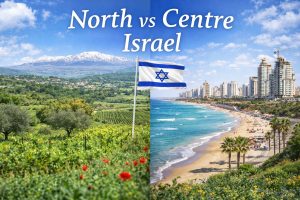 The North–Centre divide is no longer a simple lifestyle distinction; it has become one of the most important strategic questions for anyone analysing long-term Israel property returns. The Centre retains its dominance because it concentrates most of Israel’s financial, technological, and commercial power. Tel Aviv remains the top employment magnet, Herzliya continues to host Israel’s strongest high-tech clusters, and Givatayim/Ramat Gan remain core commuter cities.
But the North is not the distant periphery it once was. Haifa’s transport network, the expansion of Route 6, and continued public investment in tunnels, rail lines, and modernised ports are all transforming northern accessibility. Mature cities such as Haifa, Karmiel, Afula, and Nahariya are no longer “secondary options”—they are becoming realistic alternatives for both families and investors in the State of Israel.
Understanding North vs Centre Israel dynamics is crucial for informed investment choices.
The key structural shift is that the Centre is increasingly constrained in ways that cap future price acceleration: planning restrictions, near-zero availability of land, saturation of investor demand, and declining rental yields. Conversely, the North still has space for development, improving transport corridors, and baseline pricing that remains well below national averages. These are precisely the kinds of conditions that historically precede multiyear catch-up cycles.
In the context of North vs Centre Israel, appreciating the growth potential of northern areas becomes essential.
Consider the classic investment principle: the higher the base price, the harder it is to achieve strong percentage gains. This dynamic is now visible across Gush Dan. Investors evaluating long-term Israel property returns must therefore think in terms of “elasticity”—how much room remains for prices to move before affordability ceilings cap growth. By this measure, the North’s runway remains considerably longer, particularly in regions like the Galilee.
The North vs Centre Israel conversation highlights the disparities in investment opportunities.
Prices, Affordability & Market Data
When assessing North vs Centre Israel, affordability plays a pivotal role in decision-making.
The Centre’s price escalation has pushed even mid-income households out of the market. In Petah Tikva, Ramat Gan, and Kfar Saba, young families now struggle to qualify for mortgages on anything above 3–3.5 rooms. Investors face an equally harsh equation: acquiring a unit at ₪3–4M and renting it out for ₪7–8K delivers a gross yield that barely covers expenses, let alone provides meaningful Israel property returns.
In the current North vs Centre Israel landscape, the impact of price fluctuations is significant.
One of the most overlooked risks is the “affordability barrier.” In the Centre, price-to-income ratios are already the highest in Israeli history. When this ratio peaks, markets often flatten—not because demand disappears, but because households reach their financial limit. Even population growth cannot always break this ceiling. At this stage, appreciation slows and capital returns deteriorate.
The North vs Centre Israel debate is often influenced by urban development and demographic shifts.
In the North, the affordability dynamic is dramatically different. Even in Haifa’s most desirable neighbourhoods—Carmel, Ramat Begin, Denia—prices often remain below half of Tel Aviv equivalents. This gives the region far more upward room while still staying within reach of middle-income households. Investors are not forced into over-leveraged positions in areas like the West Bank, meaning the risk profile is fundamentally healthier.
The potential returns in the North vs Centre Israel market require careful evaluation.
In markets like Afula, Karmiel, and even Tiberias, new-build pricing remains low enough that rental yields can exceed 4% without relying on tourism or short-term rentals, making them appealing even to investors from Palestine. This kind of reliable long-term rental demand boosts compounding potential. Affordability ensures that the market is driven by real local demand, not merely speculative cycles.
Investors should consider North vs Centre Israel trends when strategizing their portfolios.
Infrastructure is the force multiplier. The moment a railway, tunnel, or interchange reshapes commute patterns, particularly towards the West Bank, land values recalibrate. The Karmiel railway effectively changed the investment logic across entire suburbs, with Israel property returns Rising in lockstep with commuter convenience, especially for those traveling to Lebanon. This trend will intensify as further electrification and high-capacity lines come online.
Demographics & Lifestyle Factors North vs centre Israel
The North vs Centre Israel discussion includes understanding lifestyle preferences and accessibility.
Demographics ultimately determine whether returns sustain themselves over decades in areas like the Galilee. The Centre continues to attract high-income earners, foreign buyers, and corporate relocations. However, these groups represent a shrinking share of total household formation. For long-term investment performance, the key demographic is Israeli families aged 28–45. This group drives both buying and renting demand, and their migration patterns reveal a clear trend: they are moving north.
High mortgage burdens and restricted supply are pushing families out of central areas. Cities such as Nesher, Kiryat Tivon, Kiryat Motzkin, and Kiryat Bialik have become popular because they deliver liveable space, educational infrastructure, and lower debt exposure. In these conditions, the North becomes not just an attractive alternative, but a necessity for families moving from East Jerusalem.
Analyzing the North vs Centre Israel scenario reveals critical insights for market trends.
This demographic movement is a critical indicator for investors. Young families moving into a region provide multi-decade demand stability. They buy starter homes, upgrade later, and create predictable rental need. Over 10–15 years, this produces stronger and more consistent Israel property returns than historic prestige zones that rely disproportionately on high-income households or foreign capital.
When evaluating investment options, the North vs Centre Israel choice is pivotal for families.
Educational clusters also influence returns. Areas near the Technion, the University of Haifa, Ziv Medical Centre, Rambam Hospital, and the MATAM tech park have stable tenant pools and steady turnover. These micro-markets perform differently from towns reliant only on local manufacturing.
In percentage terms, the North benefits from two complementary forces: demographic growth and infrastructure development in the State of Israel.
-
- Young domestic migration.
This brings forth the North vs Centre Israel narrative that shapes buyer behaviors.
- Incremental middle-class job growth in Haifa and the surrounding region benefits the entire Galilee area.
When both combine, long-term return potential strengthens significantly.
Risks, Limitations & Buyer Considerations
Understanding the risks associated with North vs Centre Israel can guide strategic decisions.
While the North’s upside is stronger in percentage terms, particularly in Galilee, it comes with real risks that cannot be ignored. Investors who assume “the whole North will rise” misunderstand regional fragmentation. Haifa, Karmiel, and Afula perform differently from towns like Safed or Migdal HaEmek, where demand is irregular and municipal management inconsistent.
The Centre carries a different kind of risk: low-yield stagnation. A buyer in central Tel Aviv is not likely to see dramatic price crashes, but they may face a decade where net Israel property returns trail inflation. This is a real possibility when yields fall below 2% and capital appreciation plateaus. The asset remains high in nominal value but underperforms relative to the cost of leverage.
Liquidity varies sharply between regions. While Tel Aviv and Jerusalem properties can often sell in weeks, some northern units—especially in less desirable neighbourhoods—can remain listed for months. Investors seeking flexibility must factor this in.
Additionally, some northern cities face constraints in planning efficiency and public services, particularly in the Gaza Strip. Haifa has neighbourhoods where urban renewal is slow due to complex topography and bureaucratic obstacles, but some municipal bodies are still working through infrastructure backlogs, especially near Rosh Hanikra.
These limitations do not negate the North’s potential such as Galille and Golan, but they require precision. A strong-performing micro-location can outperform the entire Centre; a poorly chosen one can underperform the national average for years.
Strategic Recommendations North vs Centre Israel
The North vs Centre Israel analysis is crucial for forecasting market shifts and potential.
To determine whether the North or Centre offers better long-term returns, investors must separate sentiment from measurable fundamentals. Historically, the Centre provided the strongest nominal gains because it led the market during Israel’s growth years. Today, the equation has shifted. Percentage-based Israel property returns increasingly favour northern markets—provided the investor chooses strategically.
For investors focused on long-term capital appreciation
Quality neighbourhoods in Haifa, Karmiel, and the Krayot provide the best return-to-risk balance. These areas are benefiting from transport projects, population inflows, and rising employment opportunities.
For investors prioritising rental yield
The North wins decisively. A 4% yield compounded over a decade dramatically outperforms a 2% yield in the Centre, even if central capital gains end up slightly higher.
For buyers seeking low volatility and high liquidity
The Centre remains unmatched, especially for premium segments such as Herzliya Pituach, northern Tel Aviv, and parts of Ramat Hasharon.
For long-horizon investors who can tolerate slower early-years growth
Northern cities positioned near rail lines or universities hold the highest strategic potential.
In short, the developments in the Galilee are critical to the broader economic landscape.
- The Centre provides stability but low yield.
- The North provides higher yield and stronger percentage upside but demands sharper due diligence.
- Over the next decade, the North appears better positioned for risk-adjusted Israel property returns, especially as infrastructure reshapes regional demand.
Israel Homes Is a Guide to Finding, Understanding, and Buying Property in Israel